
Normalization of blood sugar reduces enhanced rewarding effect of smoking
Why are the rewarding effects of nicotine greater in diabetic rats?
Read More arrow_forwardRats and mice communicate in ultrasound. Learn what 22 kHz and 50 kHz calls reveal about emotion, and how UltraVox detects and classifies rodent USVs
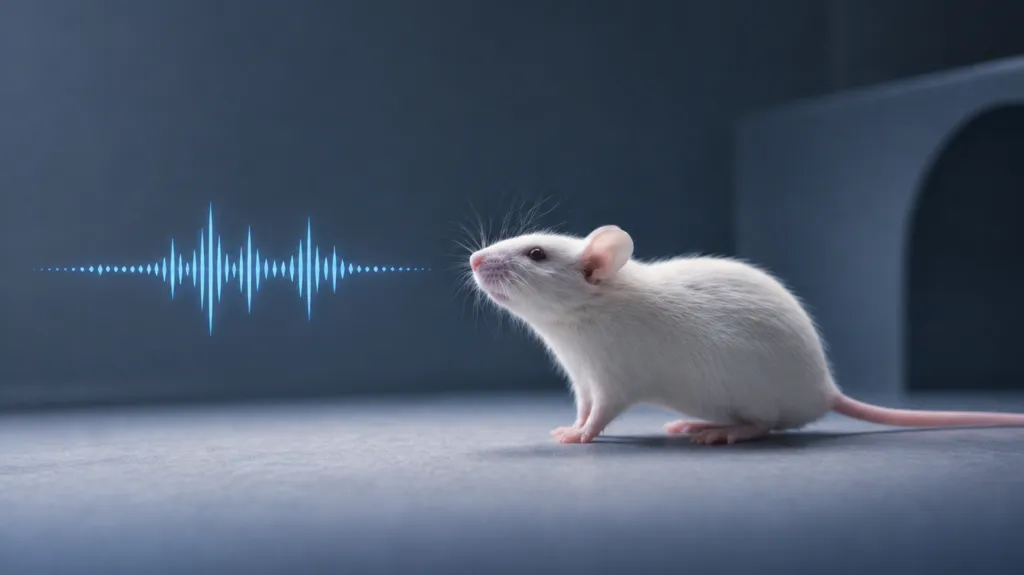
Rats and mice are social animals. They live in groups, raise their young together, play, fight, and sort out who ranks where. And like every social species, they communicate.
We tend to think of rodents as quiet. Put one in a testing room and you may hear the occasional squeak, but mostly silence. That silence is an illusion; much of the conversation is happening outside of the range of our ears.
Those ultrasonic vocalizations, or USVs, are one of the most direct windows we have into how a rodent is experiencing its world. This post covers what the calls are, why they matter for research, and how UltraVox turns them into data you can see, measure, and even hear.
Human hearing stops around 20 kHz, and that ceiling drops as we age. Most adult rat calls are well above that. To us, the room is quiet. Even a lively cage sounds quiet. To another rat, it is full of signals.
Calling in the ultrasonic range likely evolved as a survival advantage. High-frequency sound fades quickly over distance and is hard for many predators to detect, which makes it a good channel for private communication. Brudzynski's review in ILAR Journal also notes the practical side: because almost all of these calls are inaudible to us, studying them requires specialized recording equipment.
The good news is that the equipment has caught up. Spallanzani showed in the 1790s that bats navigate by ear, and by the 1800s scientists suspected that animals made sounds too high for us to hear. Proof came in 1938, when Donald Griffin and physicist George Pierce detected bat ultrasound at Harvard. Rodent USVs were first documented in the 1950s, and MIT built the first transistorized “bat detector” in 1960. Today, a modern full-spectrum ultrasound microphone and the right software can capture every call, display it, and sort it automatically.
Adult rats have two main families of ultrasonic calls, and they map onto opposite emotional states. Researchers usually name them by frequency: 22 kHz and 50 kHz.
| Feature | 22 kHz “distress” calls | 50 kHz “giggle” or “chirp” calls |
|---|---|---|
| Frequency | About 18 to 32 kHz | Above 32 kHz, often 35 to 80 kHz |
| Duration | Long, usually over 300 ms | Short, under 150 ms |
| Shape on a spectrogram | Flat, steady tone | Often frequency-modulated, with jumps and trills |
| Typical contexts | Predator cues, pain, fear conditioning, social defeat | Play, tickling, mating, anticipation of reward |
| Associated state | Negative: alarm, anxiety, discomfort | Positive: reward, social engagement |
| Neural driver | Ascending cholinergic system | Mesolimbic dopamine system |
Ranges follow the conventions summarized in this eLife study and Brudzynski's reviews.
The 22 kHz call is an alarm. It is long, low, and monotonous, closer to a held note than a chirp. Rats emit it in dangerous or aversive situations, and other rats respond to it by becoming more cautious. Brudzynski distinguishes two subtypes: long calls that signal external danger, and short calls that express discomfort when no outside threat is present.
The 50 kHz call is where things get fun. These calls show up during play, social contact, and anticipation of reward. Jaak Panksepp famously found that rats tickled by a human hand produce bursts of 50 kHz calls, which he described as a form of rat laughter. Hence the nickname: the giggle call.
Tickling has since moved from curiosity to welfare practice. Brianna Gaskill's tickle lab at Purdue University championed rat tickling as a way to improve life for laboratory rats. The technique uses a hand to mimic the rough-and-tumble play rats share with each other. Done properly, tickling makes rats easier to handle, quicker to approach people, and more likely to emit positive calls. In Gaskill and LaFollette's work, tickled rats given research injections made fewer negative audible noises and more positive USVs before and after the procedure. The giggle call, in other words, is not just a curiosity: it is a practical readout of how an animal is coping.
The sample size in this type of research is typically small since it’s hugely labor intensive. Methods to measure qualitative data are for example in-depth interviews, focus group interviews, behavioral Burgdorf and colleagues study, rats would work to hear playback of trill calls and avoided playback of 22 kHz calls, while flat 50 kHz calls had a neutral effect.
For rats, the two calls create a nice dichotomy of positive and negative emotion. For mice, however, that story is not as clean.
Mice are just as social, and in the right setting they are remarkably vocal. Most mouse calls fall between 30 and 110 kHz, higher than rat calls. What mice lack is a tidy distress call and giggle call. Researchers instead describe mouse calls by the context that triggers them and by their shape.
Three contexts are the mainstays of mouse USV research:
| Context | Who calls | What it tells you |
|---|---|---|
| Pup isolation | Pups removed from the nest, mostly in the first two weeks of life | Calls prompt the mother to retrieve the pup, and serve as an early index of emotional and social motivation |
| Social interaction | Juveniles at play, and adults meeting a same-sex partner | Social interest and motivation to engage |
| Courtship | Adult males exposed to a female or her urine | Long, structured call sequences that Holy and Guo (2005) compared to birdsong |
Within those contexts, calls are sorted by shape on the spectrogram: flat, upward, downward, chevron, complex, frequency steps, and more. Comparing how often each shape appears gives researchers a profile of an animal's vocal repertoire.
That profile has made mouse USVs a core tool for phenotyping models of neurodevelopmental disorders, especially autism spectrum conditions. Altered call patterns have been reported in many genetic mouse models. Pup calls are especially useful because they can be measured days after birth, long before most behavioral tests are possible.
The emotional meaning of mouse calls is less settled than in rats. As one review notes, the meaning of the different call categories is still being worked out. That is exactly why careful measurement matters: counting, classifying, and timing calls alongside behavior is how the field is decoding them.
In human research, one of the most valuable tools is also the simplest: ask the participant how they feel. (In market research, we often point out that people are poor judges of their own feelings, but at least we can ask.) Animal researchers never get that option. We infer emotional state from behavior instead, with outcomes like time in the open arms of the elevated plus maze, time spent immobile in the open field, sucrose preference, approach and avoidance, or stretch-attend postures.
Those measures are powerful, but they are all interpretations made from the outside. Ultrasonic vocalizations are different. They are a signal the animal produces on its own, aimed at other members of its species, about how it is doing right now. That is why USVs are often described as a window into affective state. Brudzynski argues that the two call types act as reliable indicator variables of opposing negative and positive states. A rat does not emit both at once. When it calls, it tells the room which state it is in.
Some researchers have taken the self-report idea literally. A 2013 study from the Medical University of South Carolina put it right in the title: A rodent "self-report" measure of methamphetamine craving? Mahler and colleagues recorded USVs as rats self-administered methamphetamine, went through extinction, and then returned to drug seeking during reinstatement.
Craving is one of the hardest states to study in animals, because in people it is defined by what the person says they feel. Listening to the rat offered a way in. It is not a questionnaire, and it should not be read like one. But it may be the closest thing to a self-report that preclinical research has. That opens up several research uses:
Vocalizations work best alongside behavior, not instead of it. A rat freezing in silence and a rat freezing while emitting 22 kHz alarm calls are in two different situations. Measuring both tells you what neither can alone.
Of course, context still matters. Call rates vary by species, strain, sex, age, and setup, so good baselines and controls are essential.
Nobody has time to label thousands of calls by hand. UltraVox does it in three steps.
A few details that matter:
Once calls are labeled, the spectrogram turns into something you can read immediately. Time runs left to right, frequency runs from bottom to top, and brightness shows loudness. See below for an example of a mutant mouse (in black) and a wild type mouse (in white). Data are courtesy of Karlijn van Aerde and Martien Kas, Brain Center Rudolf Magnus, University Medical Center Utrecht, The Netherlands.
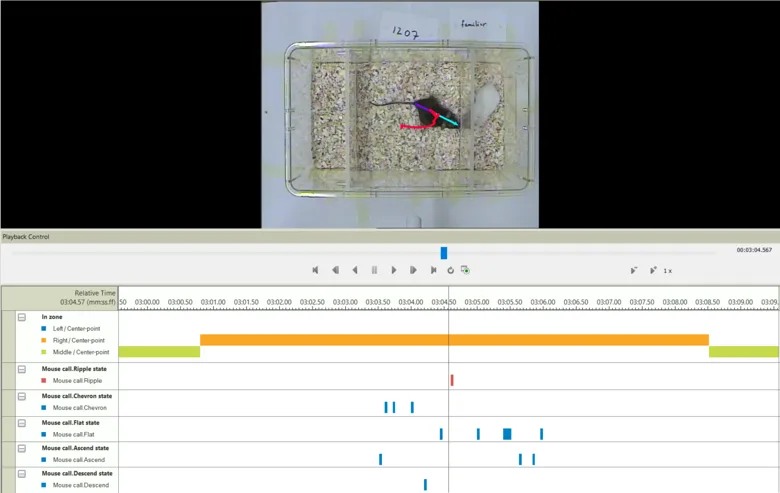
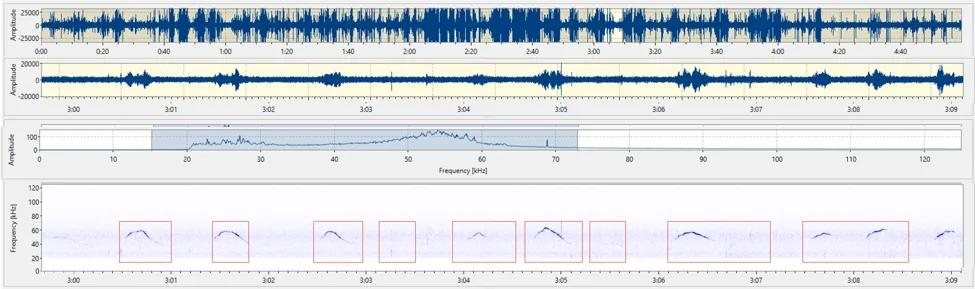
EthoVision 19 (top), showing video tracking data and imported UltraVox data. The tracked mutant mouse (black) in the right side of the central compartment sniffing a wild type mouse (white). The graph shows that the USVs occur when the animals are close to each other. UltraVox (bottom), showing the spectrogram of that same recording.
Seeing a call is one thing. Hearing it is another. To bring these calls into human range, we slowed the recordings down. Slowing playback lowers the pitch by the same factor. Slowed to one-tenth speed, a 50 kHz call drops to 5 kHz and a 22 kHz call to 2.2 kHz, both easy to hear.
Slowing also stretches time, so a 50 ms trill now lasts half a second. Keep that in mind: what sounds like a leisurely chirp is, in real time, a split-second burst.
The difference between the call types is obvious once you see it. Distress looks like a long, steady bar. Joy looks like a burst of zigzags.

A rat being tickled. Listen for rapid, rising and falling chirps. These are frequency-modulated 50 kHz trills, the calls linked to the most positive states.

Flat 50 kHz calls during calm social interaction. Steadier and less playful than the trills, more like a check-in.

A 22 kHz distress call. Long, low, and steady. Notice how different it feels from the giggle, even if you have never heard a rat before.
Most people react the same way to the first clip: they smile. That reaction is a small reminder of why these calls matter. They carry emotional information clearly enough that even another species can pick it up.
Rodents don't only show us how they feel. They tell us. For decades, most of that conversation went unrecorded because we could not hear it or we didn’t think we needed it. Now it can sit right alongside your tracking data, scored automatically and synchronized to the second.
If you already run behavioral tests, adding vocalizations is one microphone away. Want to see UltraVox on your own recordings? Request a free trial or demo, or watch Matt Feltenstein's in-depth webinar,What is your animal trying to tell you?, for a deeper look at the theory and analysis.
Why are the rewarding effects of nicotine greater in diabetic rats?
Read More arrow_forward
To find out more about human and animal learning and memory, we might just have to go to sleep. Ahem – research on sleep, I mean.
Read More arrow_forward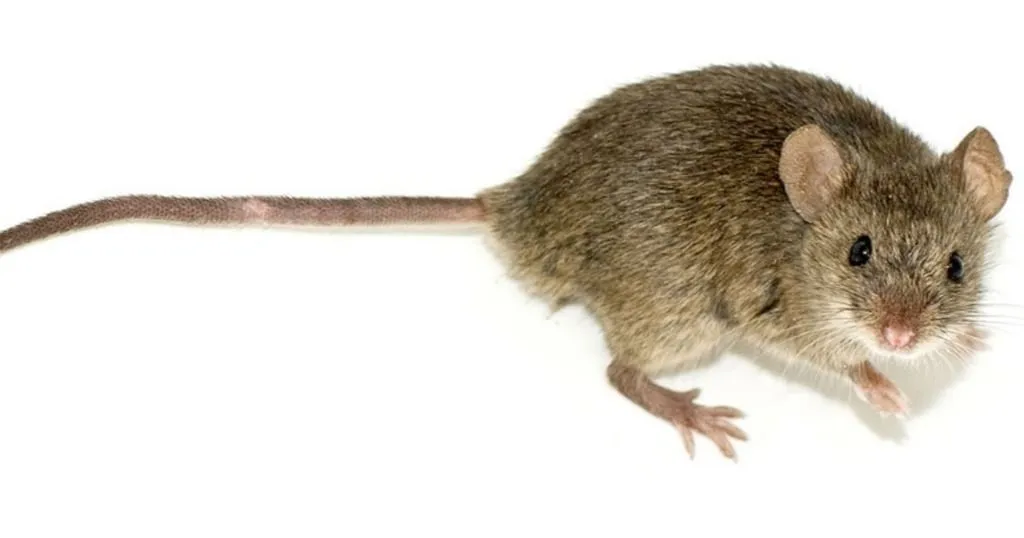
How do mice act in complete darkness? Ann-Kristina Fritz and her colleagues ordered a large, round open field with IR backlight, custom made by Noldus, to investigate.
Read More arrow_forwardWe'll get back to you shortly.
Please correct the following errors:
We look forward to seeing you at the NoldusViso launch event.
Please correct the following errors: