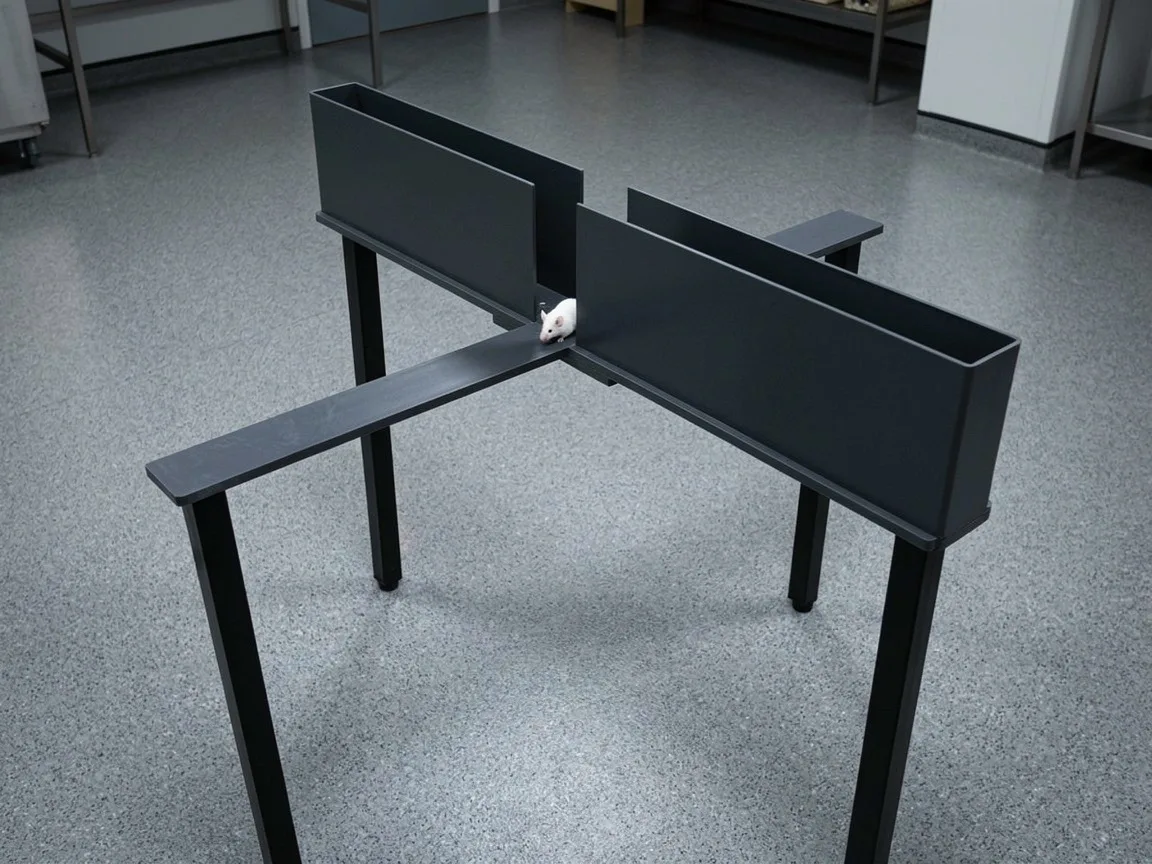
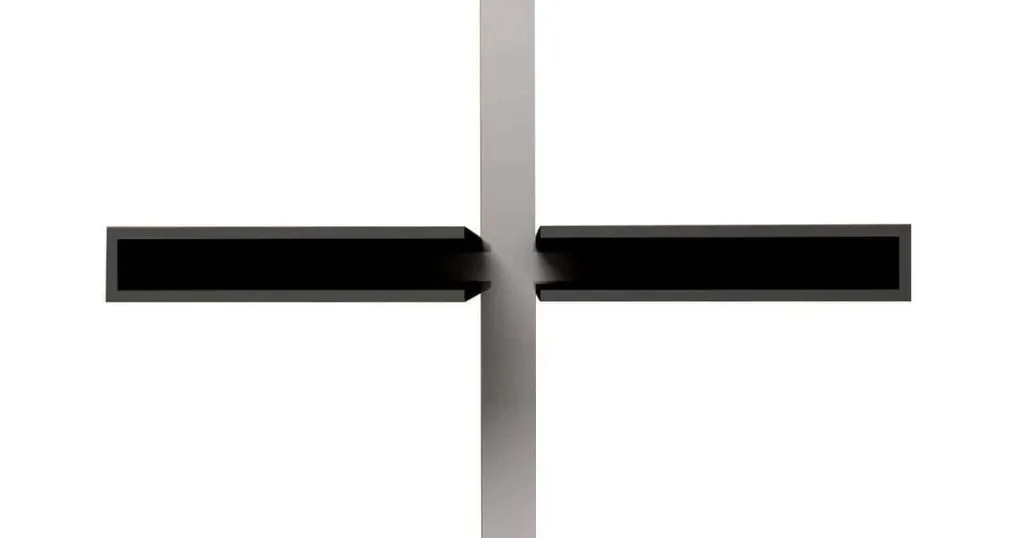
A raised, plus-shaped platform with two arms walled in and two arms open. In this blog we explain what the elevated plus maze measures, look at how labs are pairing it with EthoVision, and share practical tips for running it in your lab.
If you were able to ask a rodent what it wants, the answer is usually two things at once. It wants to explore, because a new space might hold food or a mate. And it wants to stay safe, because that same space might hold a predator. Most anxiety tests in behavioral neuroscience are built on exactly that tension. Few do it as directly as the elevated plus maze.
Why the elevated plus maze?
The elevated plus maze asks almost nothing of an animal except to move. There is no training, no food reward, no shock. A rat or mouse is placed at the center of a raised, plus-shaped platform and left to explore for five minutes. Two of the four arms have walls. Two are open, with a drop to the floor below. Rodents are drawn to explore new space, but they are also innately wary of open, elevated, unprotected ground. That built-in conflict is the whole test. How an animal resolves this conflict, staying within the closed arms or venturing into the open ones, is read as a measure of anxiety-like behavior.
That mix of simplicity and behavioral conflict is why the elevated plus maze has become one of the most used anxiety assays in rodent research. It sits alongside a handful of related conflict-based tests. However, the elevated plus maze adds height to the equation, which sharpens the conflict for many rodent strains. A widely cited methods review credits this combination of speed, low cost, and sensitivity to anxiolytic and anxiogenic drugs for the test's long research history [1].
What counts as anxiety-like behavior?
A single five-to-ten-minute trial in the elevated plus maze can generate a great number of measures. The main parameter is time in the open arms: animals that spend less time there, or enter them less often, are typically read as more anxious. Closed-arm entries serve a different purpose. They work as a locomotor control, since a drug or genetic change that simply slows an animal down would otherwise look like an anxiety effect on its own. Beyond these locational measures, researchers have long tracked related behaviors too: head dips over the edge of an open arm, and stretched-attend postures, where an animal leans out from a closed arm without committing to it.
Which of these measures a lab reports depends on the question being asked. A pharmacology screen might care about open-arm time and nothing else. A circuit-mapping study might lean on the more specific behaviors as well, since they can separate general activity from risk assessment. The studies below span that range.
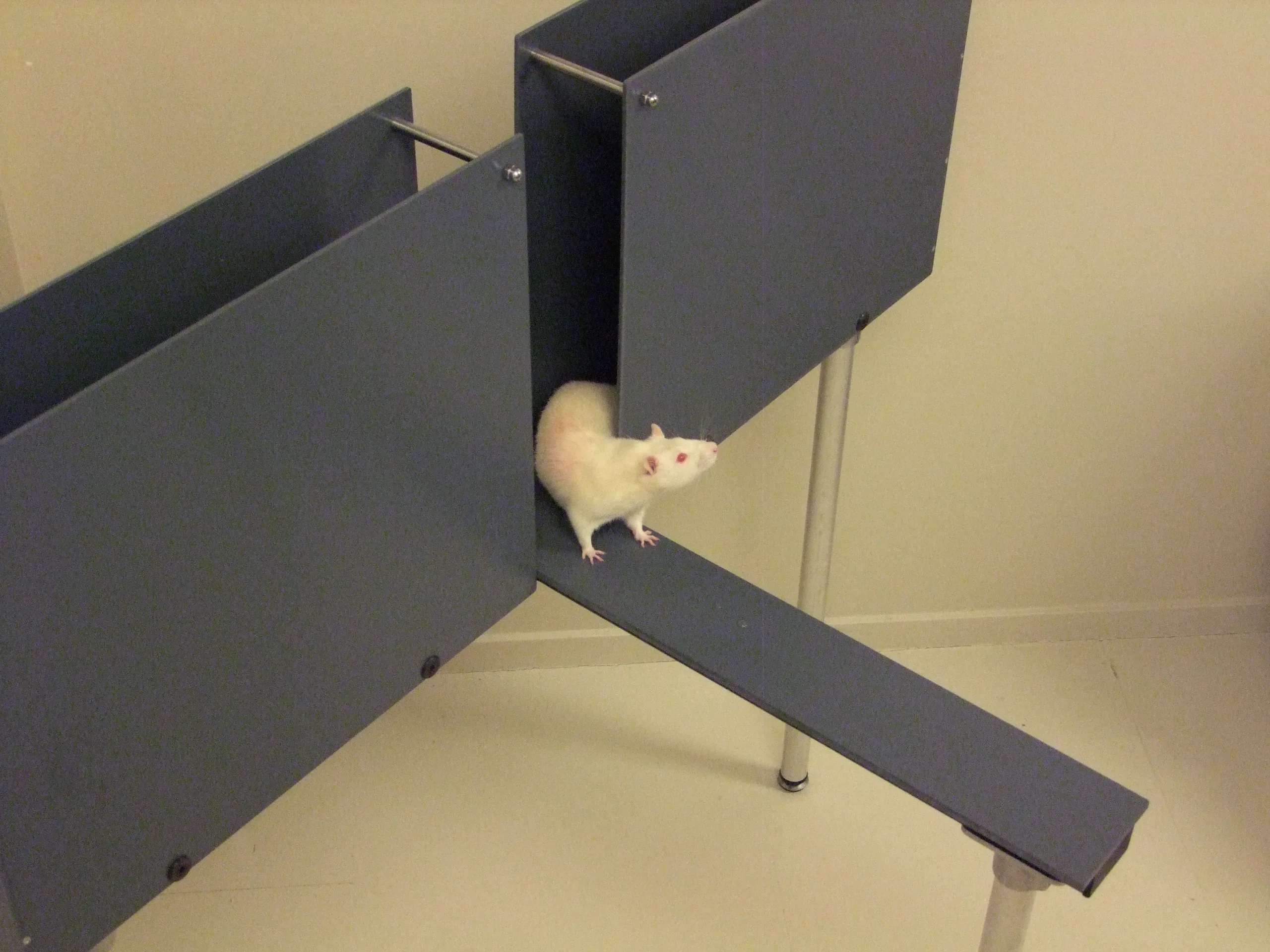
A rat exploring an elevated plus maze, with two open arms and two enclosed arms.
Applications and recent research: pairing the elevated plus maze with EthoVision
Genetics and individual differences
Chitre and colleagues asked whether common genetic variation explains why some outbred rats show more anxiety-like behavior than others. Working with 534 to 654 Sprague-Dawley rats, they combined elevated plus maze open-arm behavior with locomotor and pain-sensitivity measures, generated through video tracking, and ran genome-wide association analyses. Heritability estimates for the eleven behavioral traits ranged from 0.14 to 0.38. The team identified an independent locus on chromosome 1 tied to open-arm behavior, with candidate genes including Slc18a2, Gfra1, and Pdzd8 [5].
Stress, the gut-brain axis, and lifestyle
Nicolas and colleagues asked whether exercise could offset the effects of a disrupted gut microbiota on the brain. Rats received an antibiotic cocktail to disrupt their gut microbiota, then were kept either sedentary or given voluntary access to a running wheel. Sedentary rats with a disrupted microbiota performed worse on the elevated plus maze and other hippocampal neurogenesis-dependent tasks, tracked with EthoVision. But voluntary exercise attenuated both the behavioral changes and the underlying drop in adult hippocampal neurogenesis [6]. Yao and colleagues approached stress from the other direction. Mice that were socially isolated as adolescents and later given an induced heart attack showed a worse anxiety and depression phenotype, measured in part through elevated plus maze entries and time in the open and closed arms with EthoVision, and that phenotype correlated with reduced cardiac function after the simulated infarction [7].
Addiction and sex differences
Rivera-Irizarry and colleagues let male and female C57BL/6J mice binge drink alcohol on a voluntary schedule, then tracked how avoidance and compulsive behaviors changed during protracted abstinence. All the behavioral assays, including the elevated plus maze, were analyzed with EthoVision. Females, but not males, spent more time in the open arms during abstinence compared to water-drinking controls, a reduction in avoidance behavior. However, total distance traveled in the maze did not differ by sex or alcohol history, a useful result that rules out a simple locomotor explanation [8].
Social behavior and circuit neuroscience
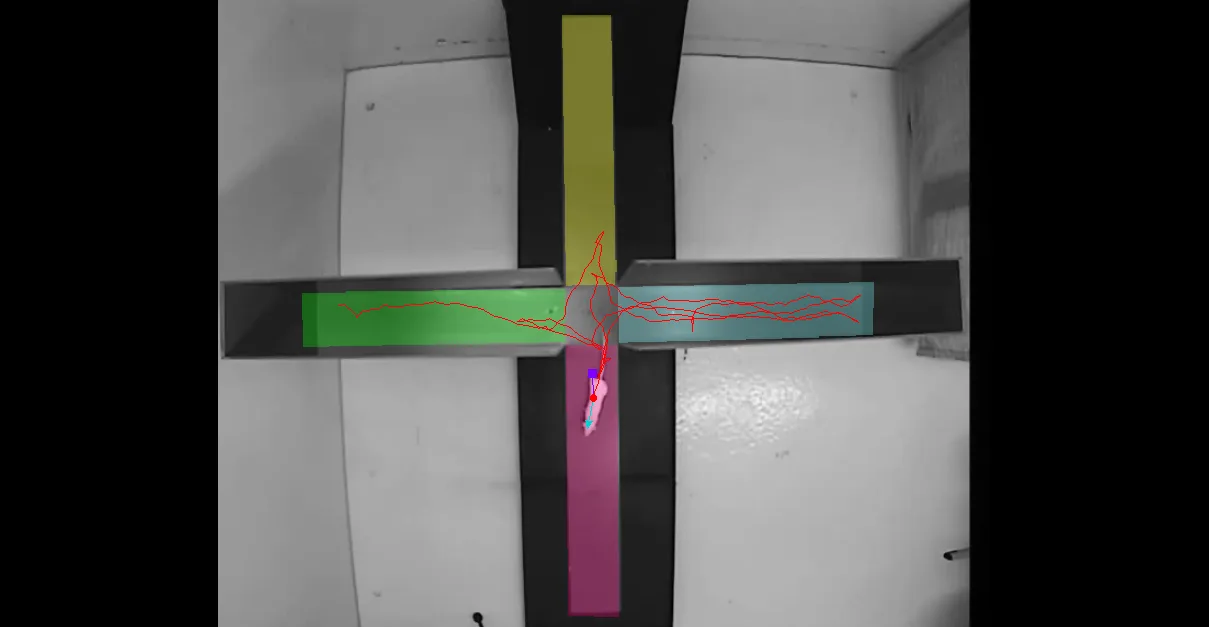
Integrated EthoVision visualization combining elevated plus maze tracking with behavioral data.
Fazekas and colleagues investigated a specific glutamate transporter, VGluT3, in a brainstem region called the median raphe that is implicated in social behavior. Mice lacking VGluT3 showed increased anxiety-like behavior in the elevated plus maze, alongside impaired social memory. When the researchers chemogenetically excited VGluT3-expressing neurons specifically in the median raphe, the effect was anxiolytic. Inhibiting the same neurons had a more mixed, context-dependent effect: it increased social interest a day later but reduced mobility and social behavior in an aggressive context [9].
When the EPM doesn't show a difference
Yu and colleagues built a new device for delivering transcutaneous auricular vagus nerve stimulation, or taVNS, to awake mice, then tested it over three weeks. Elevated plus maze and open field behavior, recorded and analyzed with EthoVision, showed no effect on anxiety-like behavior, even though the same treatment significantly improved memory [10]. Buglinina and colleagues found something similar after spinal cord injury in mice. Knocking out the receptor TAAR5 sped up sensorimotor recovery. But elevated plus maze tracking showed anxiety-like behavior stayed elevated regardless of genotype, both before and after injury [11]. Arezoumand and colleagues found a third variation on the same theme in a mouse model of Rett syndrome, a rare neurodevelopmental disorder caused by mutations in the MECP2 gene. Hemizygous male mice carrying the common T158M mutation received daily metformin for 20 days, then were tested in the elevated plus maze. Metformin had no significant effect on the mice's anxiety-like behavior. But it did significantly improve several other RTT-like symptoms in the same animals, including breathing irregularities, gait, and hindlimb clasping [12].
Pharmacology and drug development
He and colleagues took a well-known but highly toxic compound, tetrodotoxin, and reformulated it as a dissolvable oral film dosed at a fraction of its toxic level, then tested it as a candidate antidepressant in mice exposed to chronic unpredictable mild stress. Across a battery that included the elevated plus maze, tracked and analyzed with EthoVision, along with a sucrose preference test and a forced swim test, tetrodotoxin treatment reversed the depression-like drop in sucrose preference and increased immobility caused by the stress protocol. The elevated plus maze told a more qualified story: treated mice trended toward more time in the open arms, but the difference from stressed, untreated mice did not reach statistical significance [13].
Nutrition and supplements
Koc and colleagues compared three organic forms of magnesium, citrate, glycinate, and malate, in Sprague-Dawley rats over eight weeks of supplementation. Anxiety-related and cognitive behavior, including elevated plus maze entries and time recorded via EthoVision, was assessed alongside neuromuscular tests and tissue-specific magnesium measurements in brain, muscle, and vascular tissue [14].
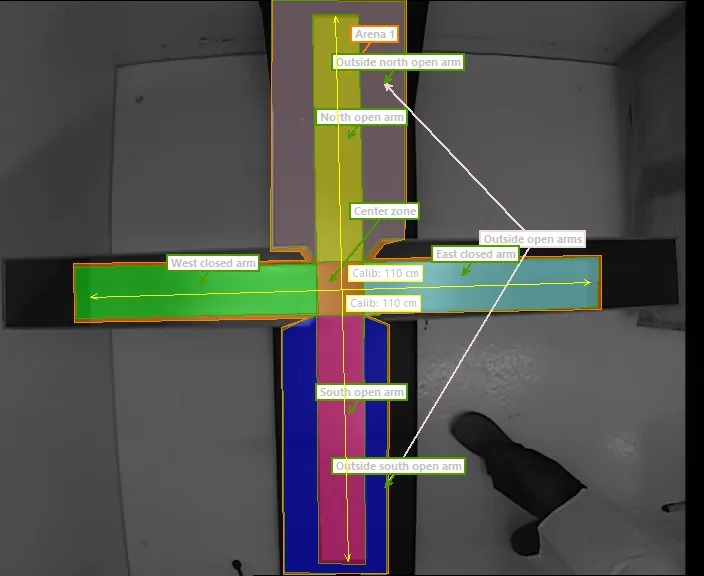
EthoVision arena settings configured for the elevated plus maze, with open and closed arms defined as separate zones.
Tips for using the elevated plus maze with EthoVision
The elevated plus maze looks forgiving, but a few habits separate clean data from a noisy dataset.
- Control lighting deliberately. Rodents show a light-sensitive anxiety phenotype: time in the open arms rises sharply at very low light levels (0 to 1 lux) compared with just 2 lux and above [3]. Keep lighting consistent across sessions and consider that infrared backlighting under dim or dark conditions can preserve tracking contrast for EthoVision without adding visible light.
- Remember it is a tactile test as much as a visual one. The maze's aversiveness relies more on tactile and proprioceptive cues, such as the edge of an open arm, than on vision alone [4]. That is worth keeping in mind when interpreting results from visually impaired strains or manipulations.
- Habituate the animals to the room. Move animals to the testing room and let them settle before the trial starts. A stressful transport or an unfamiliar room can dominate the behavior you are trying to measure.
- Clean thoroughly between animals. A wipe-down with a low-odor disinfectant between trials removes residual scent cues that could bias the next animal's exploration.
- Keep the testing schedule steady. Avoid running the elevated plus maze on days when cages are cleaned or animals are weighed, since routine handling can shift baseline anxiety and blur a treatment effect.
- Place it early in a behavioral battery. Least-stressful tests generally go first. The elevated plus maze and the open field test are both low-stress and are usually grouped early, ahead of more demanding procedures.
- Track more than open-arm time if you can. Head dips and stretched-attend postures add information that raw open-arm time does not capture on its own.
Free Trial
Want to try EthoVision with your own elevated plus maze videos?
EthoVision is the gold standard in video tracking for behavioral research. Request a free trial and see how EthoVision automates your elevated plus maze analysis.
Try it now!
arrow_forward
For more on adapting classic behavioral assays with automated tracking, have a look at our earlier blog on the open field test or radial arm maze.
Frequently asked questions
What does the elevated plus maze measure?
It measures anxiety-like behavior in rodents by tracking how much time an animal spends, and how many entries it makes, in the open, unprotected arms of a raised plus-shaped maze versus the enclosed arms.
Why does the elevated plus maze have two open arms and two closed arms?
The design creates a conflict between a rodent's drive to explore new space and its innate wariness of open, elevated, exposed areas. How the animal resolves that conflict is read as an anxiety-related choice.
What is the difference between the elevated plus maze and the open field test?
Both rely on a related conflict between exploration and avoidance of exposed space. But the elevated plus maze adds height and a forced choice between enclosed and open arms, while the open field test uses a single arena with a center and a periphery.
What is the difference between the elevated plus maze and the elevated zero maze?
Both rely on the same principles and give similar outcomes (time spent in open vs closed zones). However, the zero maze removes the ambiguous center zone, which is usually a separate area in analysis.
Can the elevated plus maze be used with both mice and rats?
Yes. It has been adapted for both species, with the apparatus scaled to the animal being tested.
What software is used to score the elevated plus maze?
Most recent studies use automated video tracking software, most commonly EthoVision or DeepLabCut, to score arm entries, time in each arm, and locomotor measures without relying on manual scoring.
References
Walf, A.A.; Frye, C.A. The use of the elevated plus maze as an assay of anxiety-related behavior in rodents. Nat. Protoc. 2007, 2, 322–328. https://doi.org/10.1038/nprot.2007.44
Pellow, S.; Chopin, P.; File, S.E.; Briley, M. Validation of open:closed arm entries in an elevated plus-maze as a measure of anxiety in the rat. J. Neurosci. Methods 1985, 14, 149–167. https://doi.org/10.1016/0165-0270(85)90031-7
Garcia, A.M.B.; Cardenas, F.P.; Morato, S. Effect of different illumination levels on rat behavior in the elevated plus-maze. Physiol. Behav. 2005, 85, 265–270. https://doi.org/10.1016/j.physbeh.2005.04.007
Filgueiras, G.B.; Carvalho-Netto, E.F.; Estanislau, C. Aversion in the elevated plus-maze: role of visual and tactile cues. Behav. Processes 2014, 107, 106–111. https://doi.org/10.1016/j.beproc.2014.08.005
Chitre, A.S.; Hebda-Bauer, E.K.; Emery, M.A.; et al. Genetic architecture of addiction-relevant behaviors in outbred Sprague-Dawley rats reveals loci for anxiety-like and nociceptive traits. Genes Brain Behav. 2026, 25, e70053. https://doi.org/10.1111/gbb.70053
Nicolas, S.; Dohm-Hansen, S.; Lavelle, A.; et al. Exercise mitigates a gut microbiota-mediated reduction in adult hippocampal neurogenesis and associated behaviours in rats. Transl. Psychiatry 2024, 14, 195. https://doi.org/10.1038/s41398-024-02904-0
Yao, Y.; Wang, A.; Di, C.; et al. Long-term social isolation during adolescence exacerbated cardiac dysfunction after myocardial infarction. Transl. Psychiatry 2026, 16, 193. https://doi.org/10.1038/s41398-026-03959-x
Rivera-Irizarry, J.K.; Zallar, L.J.; Levine, O.B.; et al. Sex differences in binge alcohol drinking and the behavioral consequences of protracted abstinence in C57BL/6J mice. Biol. Sex Differ. 2023, 14, 83. https://doi.org/10.1186/s13293-023-00565-0
Fazekas, C.L.; Török, B.; Correia, P.; et al. The role of vesicular glutamate transporter type 3 in social behavior, with a focus on the median raphe region. eNeuro 2024, 11, ENEURO.0332-23.2024. https://doi.org/10.1523/ENEURO.0332-23.2024
Yu, Y.-M.; Yao, R.; Liu, Z.-L.; et al. Feasibility and effectiveness of transcutaneous auricular vagus nerve stimulation (taVNS) in awake mice. CNS Neurosci. Ther. 2024, 30, e70043. https://doi.org/10.1111/cns.70043
Buglinina, A.D.; Romanyuk, E.A.; Chesnokov, A.A.; et al. TAAR5 modulates sensorimotor recovery after spinal cord injury. Biomedicines 2026, 14, 796. https://doi.org/10.3390/biomedicines14040796
Arezoumand, K.S.; Akhtar, G.B.; Kadar Shahib, A.; et al. Metformin treatment shows beneficial effects on RTT-associated phenotypical deficits in Mecp2 T158M male mice. Pharmaceuticals 2026, 19, 621. https://doi.org/10.3390/ph19040621
He, J.; Tang, C.; Niu, S.; Le, Q.; Yu, L.; Hong, B. Tetrodotoxin oral film attenuates depression in a chronic unpredictable mild stress model in mice. Mar. Drugs 2026, 24, 94. https://doi.org/10.3390/md24030094
Koc, B.; Hosgorler, F.; Kandis, S.; et al. Chronic organic magnesium supplementation enhances tissue-specific bioavailability and functional capacity in rats: a focus on brain, muscle, and vascular health. Biol. Trace Elem. Res. 2025. https://doi.org/10.1007/s12011-025-04678-y