Imagine you are on a deserted island, and you are hungry. You explore to the right, find a tree full of fruit, eat your fill, and head back to your shelter for the night. The next morning, where do you go? To the right, of course, because your spatial memory is functioning normally.
Now imagine that memory is starting to fail. You forget where the fruit was, or you keep returning to a tree you already stripped bare. In many neurological conditions, this is exactly the kind of spatial and working memory that breaks down first. The Y-maze is one of the most efficient tools we have for studying it.
Y the maze?
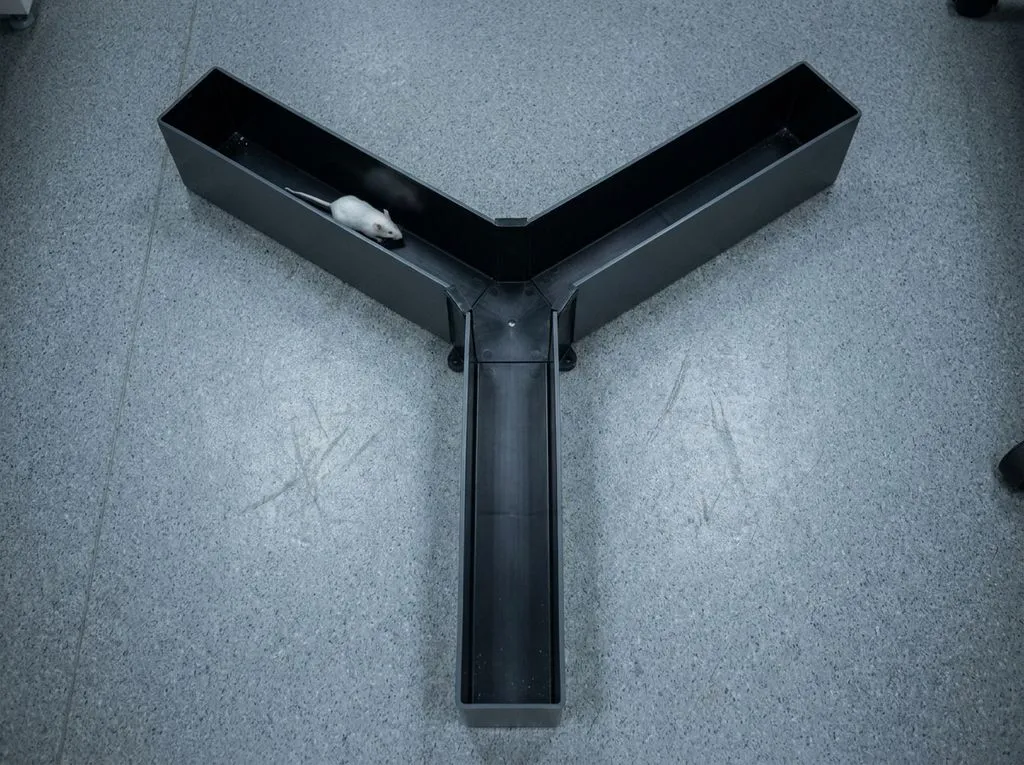
A Y-maze is exactly what it sounds like: a maze with three identical arms set at 120 degrees to one another. It is very similar in form and function to the T-maze, but the gentler turns are easier for an animal to negotiate and decide. Kraeuter and colleagues, in a widely used protocol paper, describe how this small, low-stress apparatus can probe both spatial working memory and spatial reference memory, drawing on the hippocampus, medial septum, prefrontal cortex, and basal forebrain [1].
And because its most popular variant, spontaneous alternation, relies only on a rodent's natural drive to explore somewhere new, it needs no food deprivation, no aversive stimuli, and very little training. That makes it fast, repeatable, and low stress.
What can you measure in a Y-maze?
The Y-maze can accommodate a variety of protocols. To probe spatial reference memory, you can bait one arm with a reward and, at a later point, see whether the animal heads straight back to it. To test recognition memory, you block one arm during the first exposure and then open it: a healthy animal notices the "new" arm and spends more time exploring it, much like in novel object recognition.
In the spontaneous (or continuous) alternation test, you simply let the animal roam. Rodents tend to alternate arms rather than revisit the same one, so the percentage of successful alternations becomes a clean readout of working memory. And in rewarded alternation, you teach the animal that the reward keeps moving, so it has to alternate to succeed.
Across all of these, the same handful of measures matter: which arm is entered, in what order, how quickly, and for how long. Counting these parameters by hand is exactly the slow, subjective step that automation removes.
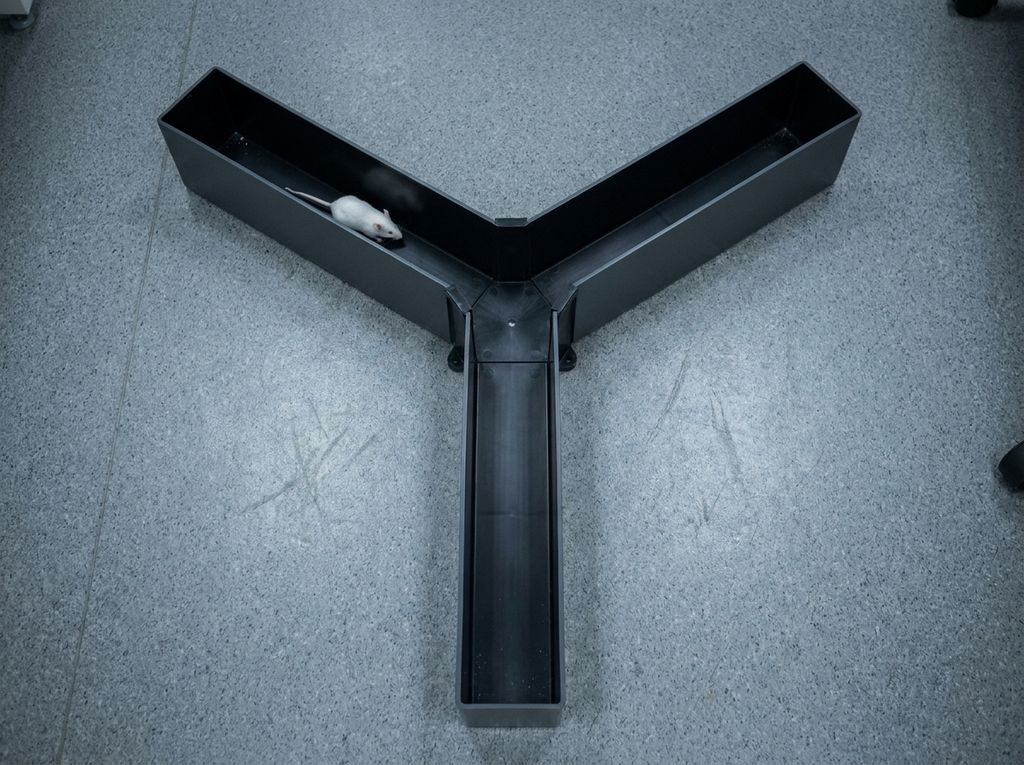
Applications of the Y-maze
Spatial and working memory are affected in a remarkable range of disorders, and recent work shows just how broadly the Y-maze travels.
Alzheimer's disease and dementia
Aleksandrova and colleagues used a delayed spontaneous-alternation Y-maze (videotaped and scored with EthoVision) alongside the Morris water maze and novel object recognition to show that a conjugate of securinine and tryptamine improved memory in 5xFAD transgenic mice, a model that overexpresses mutant human amyloid [2].
Traumatic brain injury
Pischiutta and colleagues used a two-trial Y-maze to test whether a mesenchymal stromal cell secretome could restore spatial recognition memory in injured mice; the time spent in the novel versus familiar arm was a key outcome [3]. In a separate 2026 study, Sheng and colleagues paired the Y-maze with novel object recognition and the Morris water maze to show that silencing a neuronal inflammasome rescued cognition after controlled cortical impact [4].
Anesthesia and vulnerable brains
Li and colleagues exposed P301L tau transgenic mice (a tauopathy model) to the anesthetic sevoflurane and measured spontaneous alternation in the Y-maze together with novel object recognition, finding that anesthesia worsened tau-related memory deficits [5].
Compound screening
Yi and colleagues used Y-maze spontaneous alternation and a novel-arm task, benchmarked against the reference drug donepezil, to test an Alpinia oxyphylla fruit extract in a lipopolysaccharide (LPS) model of neuroinflammation [6].
Fatigue and stress
Wu and colleagues induced cognitive fatigue in rats through repeated sleep deprivation and found a reduced spontaneous-alternation rate in a Y-maze. The effect was regionally specific: prefrontal TGF-B1 rose, but peripheral and striatal levels did not change [7].
Not only rodents: the Y-maze for zebrafish
The Y-maze is not just for rodents. The zebrafish (Danio rerio) has become a widely used model in translational neuroscience, because it shares conserved neurotransmitter systems and disease-related genes with mammals, breeds quickly, and is well suited to higher-throughput testing.
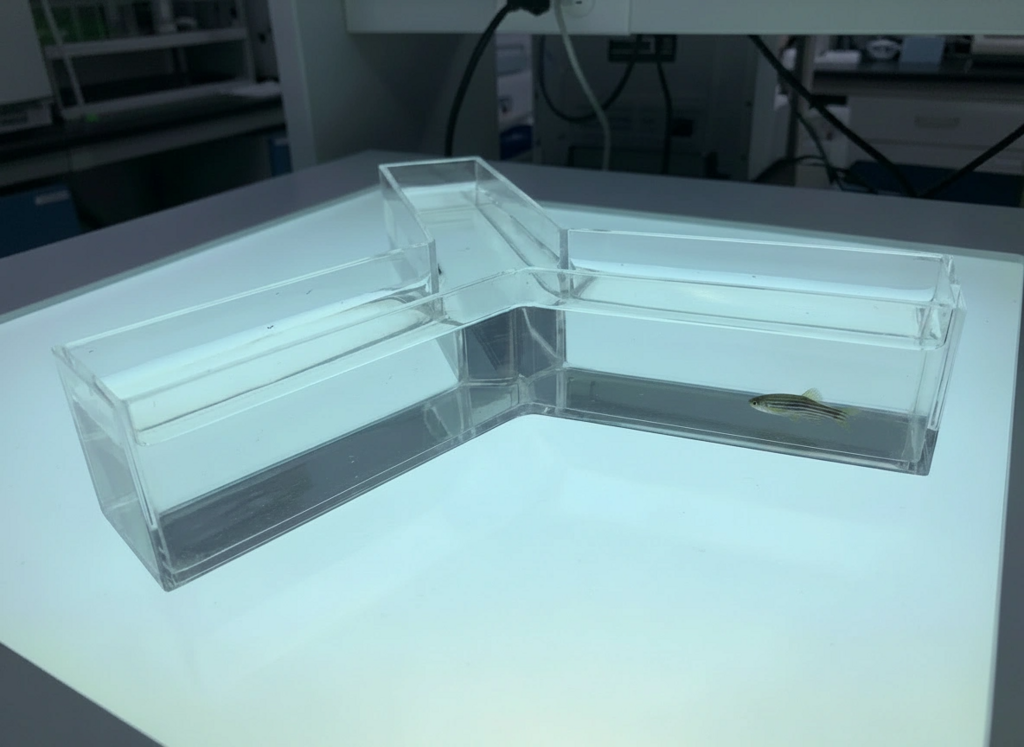
In a Y-shaped tank, an adult zebrafish explores the arms much as a rodent does, and the same logic applies: a fish with intact memory alternates its choices or favors a newly opened arm.
Popovici and colleagues used precisely this approach (a novel tank test, a Y-maze, and novel object recognition) to show that a Phytolacca americana fruit extract reversed scopolamine-induced memory loss in zebrafish [8]. Using the identical setup, the group later showed that the plant coumarin scoparone eased comparable scopolamine-induced memory and anxiety deficits in zebrafish [9].
The underlying paradigm has been carefully validated, too: Cleal and colleagues established the free-movement-pattern Y-maze as a cross-species measure of working memory and executive function, scored from the sequence of left and right turns a fish makes during free exploration [10]. Because the task is, in essence, "just filming a fish swimming," it lends itself naturally to video tracking.
A Y-maze for snakes?
Yes, it sounds a bit unusual, but the Y-maze is not only used in neuroscience. Researchers from James Madison University and the Fort Collins Science Center used an enclosed version (for obvious reasons) of the Y-maze to assess the exploratory behavior of Burmese pythons. Since snakes have an incredible sense for chemical cues, the researchers used this to their advantage to observe choice behavior.
Automating the Y-maze with EthoVision
Regardless of the model species, the bottleneck is the same: arm entries are only meaningful if they are scored accurately and consistently, trial after trial. With EthoVision, deep-learning detection finds the nose, body center, and tail base of a rodent or fish, so an arm entry is registered only when the animal has genuinely committed to that arm, not merely poked its nose past the threshold. The software then reports the order of arm visits, latencies, durations, and the alternation percentage automatically.
The current release, EthoVision 19, builds on this with quality-of-life and multi-subject improvements: a Noldus Calibration Card that focuses the camera and calibrates an arena at the click of a button, refined AI models that return data within seconds of a recording, and much more. Your whole experiment is automated and standardized, giving you clean, high-quality data.
Try EthoVision with your own Y-maze videos!
The gold standard in video tracking for behavioral research. Request a free trial and see how EthoVision automates your Y-maze experiments.
Request a free trial
In conclusion
The Y-maze endures because it does something deceptively hard: it makes a private, internal process (remembering where you have just been) visible as a simple sequence of choices. What turns that into reliable science is precise, scalable, objective measurement, and that is exactly what automated tracking provides.
The studies above span amyloid and tau pathology, brain injury, anesthesia, neuroinflammation, fatigue, and a fish model of amnesia, yet they share one quiet ingredient: every arm entry was scored the same way, every time. That consistency is what lets researchers trust a subtle effect, or, just as importantly, an absent one.
For more on adapting cognitive assays across species, take a look at our work on learning and memory testing and zebrafish research. If you would like to talk through how the Y-maze could fit your own study, we are happy to help.
Further reading: more recent Y-maze studies that use EthoVision
These two studies are good next reads if you want to see the same EthoVision-tracked Y-maze applied in fresh contexts:
Yang and colleagues put a Y-maze (arm entries and spontaneous alternation, tracked with EthoVision) at the center of a quantitatively controlled closed-head injury model, linking head-impact intensity to impaired adult neurogenesis [11].
Kim and colleagues used Y-maze spontaneous alternation together with the Morris water maze, both tracked with EthoVision, to compare two anesthetics for postoperative cognitive decline in an Alzheimer's-risk (ApoE4) mouse model [12].
References
Kraeuter, A.-K.; Guest, P.C.; Sarnyai, Z. The Y-Maze for Assessment of Spatial Working and Reference Memory in Mice. Methods Mol. Biol. 2019, 1916, 105-111.
Aleksandrova, Y.; et al. Neuroprotective Effects and Cognitive Enhancement of Allomargaritarine in 5xFAD Alzheimer's Disease Mice Model. OBM Neurobiol. 2024, 8, 207.
Pischiutta, F.; et al. Mesenchymal Stromal Cell Secretome and Its Key Bioactive Metabolites Induce Long-Term Neuroprotection After Traumatic Brain Injury in Mice. Adv. Sci. 2025, 12, e15508.
Sheng, J.; et al. A self-perpetuating neuron-intrinsic GSDMD-mtDNA-AIM2 inflammasome axis drives neuronal pyroptosis after traumatic brain injury. Front. Immunol. 2026, 17, 1867920.
Li, Y.; et al. Sevoflurane Exposure Exacerbates Memory Impairment in P301L Tau Transgenic Mice. CNS Neurosci. Ther. 2025, 31, e70694.
Yi, Z.; et al. Identification, biotransformation, and neuroprotective potential of Alpiniae oxyphyllae fructus in neuroinflammation-related cognitive impairment. Front. Pharmacol. 2025, 16, 1714500.
Wu, Y.; et al. Cognitive impairment and prefrontal TGF-B1 elevation in a rat model of fatigue. Front. Psychiatry 2026, 17, 1841951.
Popovici, L.-F.; et al. Enhancement of Cognitive Benefits and Anti-Anxiety Effects of Phytolacca americana Fruits in a Zebrafish Model. Antioxidants 2025, 14, 97.
Brinza, I.; et al. Enhancement of cognitive benefits and anxiolytic effects of scoparone in a zebrafish model. Pharmacol. Res. Nat. Prod. 2025, 7, 100232.
Cleal, M.; et al. The Free-movement pattern Y-maze: a cross-species measure of working memory and executive function. Behav. Res. Methods 2021, 53, 536-557.
Yang, S.; et al. Quantitatively controlled traumatic brain injury impairs adult neurogenesis in mice. Theranostics 2026, 16, 193-219.
Kim, J.-H.; et al. Comparison of Cognitive Deterioration Between Propofol and Remimazolam Anesthesia in ApoE4 Knock-In Mouse Model. Int. J. Mol. Sci. 2025, 26, 5718.