Heinrich Heine University
Social learning task in rats
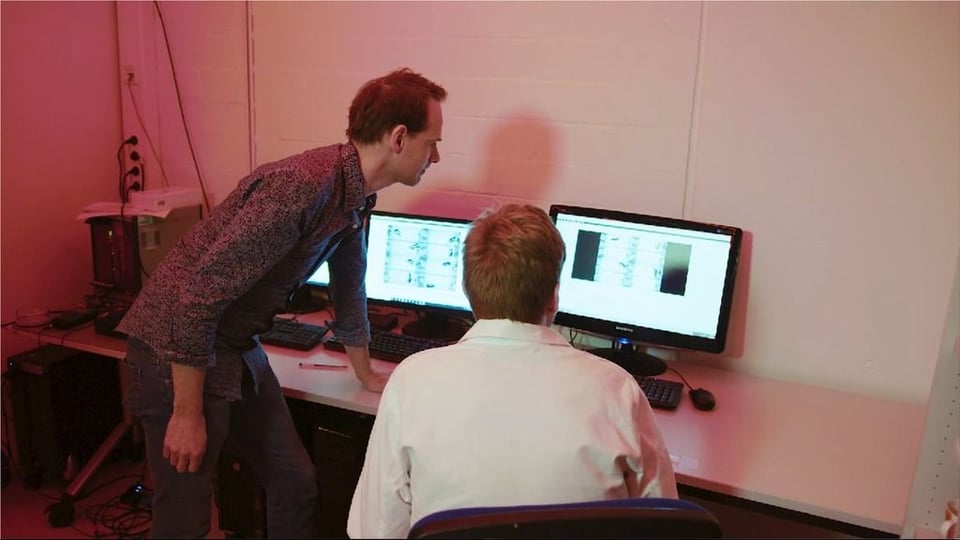
At the Heinrich Heine University in Düsseldorf, Germany, PI Dr. Marijn van Wingerden and his PhD student Sander van Gurp study social learning behavior in rats. Their Social Rodent Lab uses EthoVision XT and UltraVox for their behavioral studies.
Measuring social value in rats
How the Social Rodent Lab at Heinrich Heine University combines EthoVision and UltraVox to study how rats learn from each other.
Key takeaways
- The lab studies how social value affects decision-making in rats.
- In a social reinforcement learning task, rats learn from each other.
- EthoVision tracks position and behavior, UltraVox records the vocalizations.
- The model may help develop interventions for autism and schizophrenia.
Dr. Marijn van Wingerden is the PI of the Social Rodent Lab at Heinrich Heine University in Düsseldorf. The lab is interested in social value and the social behavior of animals: how animals interact with their social partners, and how that interaction is coded in the brain.
Studying social value, as opposed to self-value, matters to him for a simple reason.
Most of the interactions that we have on a day to day basis are taking place in a social context.
Can rats learn from each other?
One of the lab’s experiments is the social reinforcement learning task, developed by PhD student Sander van Gurp. It looks at whether social value affects decision-making in an observer rat. Two rats are trained, first separately and then together. The question is whether something good happening to the partner rat affects learning in the observer rat.
Smell plays a role too. When one rat smells another rat’s breath, it can tell that the other rat has eaten. In one condition, both rats are rewarded: the observer sees and hears its partner getting a reward, and then finds out that it is rewarded as well. By studying how the rats communicate about what they just experienced, the team learns how they learn about the rewarding event.
Tracking movement and vocalizations
The lab combines EthoVision, which tracks the position and behavioral state of the animals, with UltraVox, which records the ultrasonic vocalizations they make. Ultrasonic vocalizations are an important marker of an animal’s affective state. In the task, the partner rat is sometimes rewarded and sometimes not, and that difference can lead to different emotional states.
From behavior to brain circuits
Next, Dr. van Wingerden wants to look more closely at how the observed behavior relates to the underlying brain circuits. By finding out what a specific brain area does, the team can better understand how it affects the rest of the circuit that regulates social reinforcement learning.
The goal is to further develop and validate this model of social interaction, so it can generate predictions that transfer to humans. Patients with autism or schizophrenia often have impairments in social functioning. A good animal model that captures social behavior may help develop interventions for these patient groups.
UltraVox
Ultrasonic vocalizations made easy
Discover how UltraVox records and analyzes ultrasonic vocalizations, and how it works together with EthoVision.
Interested in similar results?
Get in touch!
Want to achieve the same research quality as Heinrich Heine University? Let us show you how our tools can support your work. Book a demo or request more information.
Thank you!
We will get back to you within one business day.

Thank you!
We'll get back to you shortly.
Please correct the following errors:
Thank you for registering!
We look forward to seeing you at the NoldusViso launch event.
Please correct the following errors: