Centre for Infant Cognition
University of British Columbia
The Centre for Infant Cognition (CIC), at the University of British Columbia, in Vancouver, Canada, uses analysis tools provided by Noldus for detailed behavioral coding. Noldus’ MediaRecorder is used to record study sessions and is installed on multiple online coding stations.
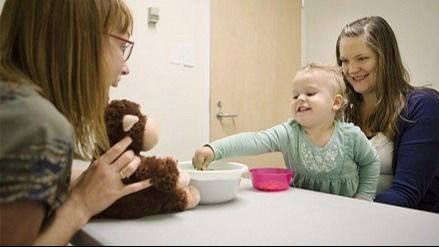 Image provided by CIC
The cameras used in their studies are controlled by Noldus software, which contains adjustable camera angles offering optimal viewing points. This allows the researchers to fully capture an infant’s eye gaze and body behavior during a study.
Analyzing infants behavior in detail
Additionally, the CIC uses The Observer to record study events, and further analyze this data. It allows them to analyze behavior processes at a very detailed level that could not be obtained manually.
More specifically, it is used to look at minute (small/precise) eye gaze changes, hand gestures, and emotions of infants while they are observing a moral dilemma or social interaction, which is usually depicted in a puppet show. For example, when the infant is asked to share treats with the puppet.
The Centre for Infant Cognition at the University of British Columbia is headed by Dr. Kiley Hamlin. It is a part of the Early Development Research Group, and examines infants’ evaluations of moral dilemmas and social interactions. The purpose of their research is to understand how infants reason about their surrounding environment.
CIC participates in ManyBabies projects
A global network of more than 500 developmental researchers, including the research team of CIC, are involved in the ManyBabies projects. Their goal is to address difficult outstanding theoretical and methodological questions about the nature of early development and how it is studied.
The projects are organized in main projects (either empirical or methodological), spin-off projects, and secondary analyses. The 6 empirical projects aim to gain knowledge by means of direct and indirect observation or experience.
Read the blog arrow_forwardInterested in similar results?
Get in touch!
Want to achieve the same research quality as University of British Columbia? Let us show you how our tools can support your work. Book a demo or request more information.
Thank you!
We will get back to you within one business day.
Thank you!
We'll get back to you shortly.
Please correct the following errors:
Thank you for registering!
We look forward to seeing you at the NoldusViso launch event.
Please correct the following errors: