Assessing anxiety and depression in rodents
University of Toronto
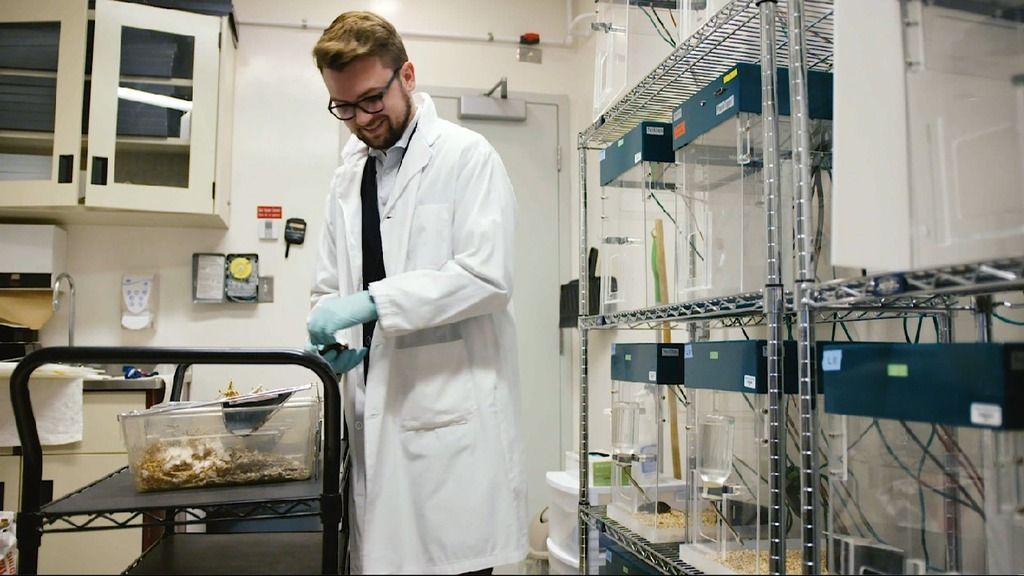
Dr. Thomas Prévôt from the University of Toronto is developing a new tool to assess anxiety-like and depressive-like behavior in rodents, in order to understand the underlying mechanisms of chronic stress exposure and how it changes either behavior but also molecular and cellular pathology, to mimic the human depression.
Tracking the path from stress to depression
How a postdoc at the University of Toronto turned the PhenoTyper into a repeatable window on anxiety and depression in mice.
"What I do here is developing a new tool to assess anxiety-like and depressive-like behavior in rodents," says Dr. Thomas Prévôt, a postdoctoral fellow in preclinical neuroscience at the University of Toronto. The goal is to understand the underlying mechanisms of chronic stress exposure, how it changes behavior, and the molecular and cellular pathology beneath it, in order to mimic human depression.
A reliability problem in the field
Assessing anxiety- and depressive-like behavior reliably is harder than it sounds. "Right now it's very difficult to repeat the assessment in mouse models for anxiety and depression," Prévôt explains. The classic behavioral tests, the elevated plus maze, the open field, the forced-swim test, share a built-in limitation: in mice, you generally cannot run them on the same animal multiple times. Measure once, and the window closes.
A new assay in the PhenoTyper
So the lab built a different approach around Noldus PhenoTyper boxes. Animals are housed in the boxes overnight, and in the middle of the night a light is shone inside to induce an acute stressor. "With that tool," Prévôt says, "we would be able to assess anxiety-like behavior, and the trajectory of that behavior, every week in the same animals." That last part is the breakthrough: a repeatable, longitudinal read-out where the old tests could only offer a single snapshot.
"With that tool we would be able to assess anxiety-like behavior, and the trajectory of that behavior, every week in the same animals."
From mechanism to therapy
The research works on several levels at once. First comes understanding the mechanism: how chronic stress induces anxiety- and depressive-like behaviors, and how those behaviors tie back to the cellular and molecular pathology. "By understanding the underlying mechanism," Prévôt notes, "we can target those mechanisms in order to develop new therapeutics."
That is where the longitudinal design pays off. Candidate therapeutics can be tested in the same animals over time in the PhenoTyper, to see whether they genuinely alleviate the anxiety- and depressive-like behavior rather than just shifting a one-off measurement. "If this is successful, we can bring those new therapeutics to humans, because potentially, if they work in rodents, they can be beneficial for human pathology as well."
It is a clear line of sight from a mouse in a box to a future treatment: a reliable, repeatable behavioral read-out, linked to the biology underneath it, pointed squarely at the mechanisms that drive anxiety and depression.
Interested in similar results?
Get in touch!
Want to achieve the same research quality as University of Toronto? Let us show you how our tools can support your work. Book a demo or request more information.
Thank you!
We will get back to you within one business day.
Thank you!
We'll get back to you shortly.
Please correct the following errors:
Thank you for registering!
We look forward to seeing you at the NoldusViso launch event.
Please correct the following errors: