The science behind your emotions
Have you ever wondered where your emotions come from? Let’s dive into the science behind our emotions and discover how our brain and body work together to make us feel.
Read More arrow_forwardA new TSC mouse model shows how a small cortical lesion can trigger epilepsy and behavior changes.
Epilepsy affects most individuals with tuberous sclerosis complex, or TSC, yet the link between small cortical abnormalities and seizure generation is not fully understood. In a new study published in Frontiers in Molecular Neuroscience [1], researchers in Dr. Candi LaSarge's lab at Cincinnati Children's and the University of Cincinnati introduced a mouse model designed to answer a central question: Is a small, localized disruption in the frontal cortex enough to trigger epilepsy and related behavioral changes? The results show that it is, and they also demonstrate how automated behavioral tracking can support this type of research.
TSC is caused by mutations in the genes Tsc1 or Tsc2, which alter the mTOR pathway and affect cell growth. Many patients develop focal cortical lesions, known as tubers, that are strongly associated with seizures. However, it has been unclear whether such focal abnormalities alone are sufficient to create epileptic networks, or whether more widespread developmental changes are required.
To test this directly, the research team deleted Tsc2 in a very small area of the frontal cortex shortly after birth. This approach allowed them to isolate the effects of a discrete lesion without disrupting the rest of the brain.
Even though the lesion was small, its impact was significant.
In addition to physiological outcomes, the team examined how the focal lesion influenced natural exploration. Behavior provides an essential complement to cellular and EEG data because it reflects how neural disruptions affect real-world function. Mice were placed in an open field arena for thirty minutes while their movement was tracked with EthoVision. This allowed the team to quantify locomotion and spatial preferences with high accuracy.
The results showed a consistent pattern. Mice with the Tsc2 deletion explored the arena but avoided the center area. They displayed high thigmotaxic behavior, meaning they remained close to the walls, which is often interpreted as increased anxiety. Importantly, the groups did not differ in total distance traveled. This means the shift in exploration strategy was not caused by reduced mobility but by a change in how the animals chose to explore the space.
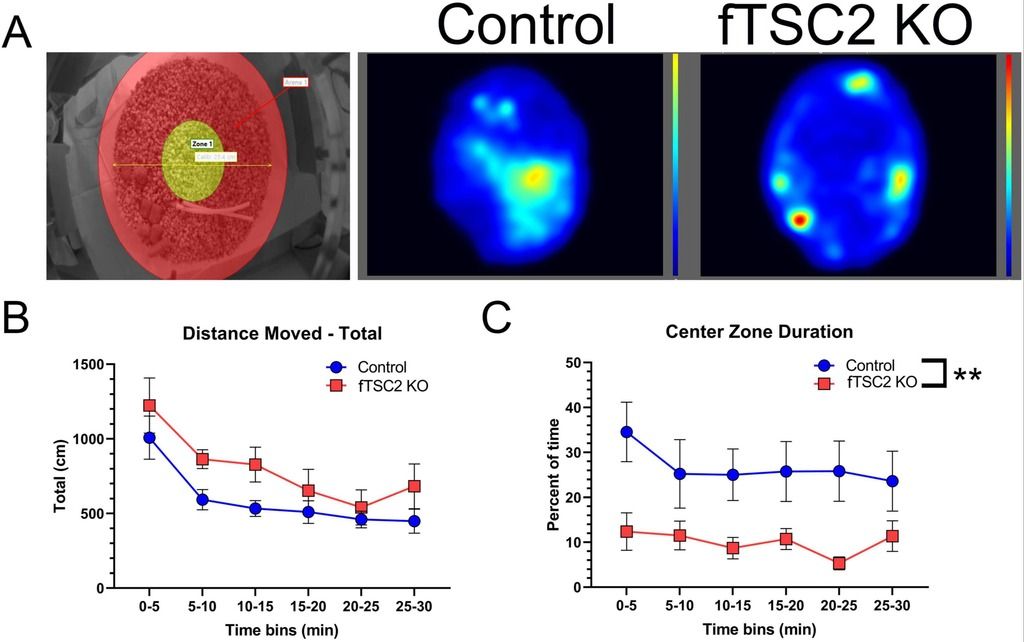
Copyright © 2025 McCoy, Dusing, Jerow, Winstel, Zhan, Rogers, Wesley, Otten, Danzer and LaSarge
EthoVision supported the study by providing reliable, high resolution movement data in a simple and unobtrusive way. The software allowed the researchers to quantify center time, thigmotaxis, and locomotor activity without manual scoring. These measures helped reveal the behavioral effects of the focal lesion and supported the broader conclusion that local cortical disruptions can influence both seizures and behavior.
Automated tracking is especially helpful in TSC and epilepsy research. Many behavioral changes are subtle, and consistent quantification is important when linking behavior to cellular and network level findings.
FREE TRIAL
Request a free trial and find out what EthoVision XT can do for your research!
This focal TSC model brings together several important features of the disorder. It produces seizures, altered inhibitory circuits, neuroinflammation, and changes in exploration. Because the lesion is small and well defined, the model can help researchers investigate how specific cortical disruptions lead to epileptic activity and behavioral consequences.
By combining EEG, histology, and automated behavioral tracking, the researchers created a comprehensive picture of how focal pathology affects the whole animal. This integrated approach will support future studies on epileptogenesis, circuit dysfunction, and potential therapeutic interventions.
[1] McCoy C, Dusing M, Jerow LG, Winstel GC, Zhan F, Rogers JL, Wesley M, Otten JB, Danzer SC and LaSarge CL (2025). Focal postnataldeletionof Tsc2 causes epilepsy. Front.Mol.Neurosci. 18:1686023. https://doi.org/10.3389/fnmol.2025.1686023.
Have you ever wondered where your emotions come from? Let’s dive into the science behind our emotions and discover how our brain and body work together to make us feel.
Read More arrow_forward
In my previous blog post, I shared some of the basics of cognitive neuroscience. In this blog post, we will zoom into a more specific part of cognitive neuroscience: emotions.
Read More arrow_forward
Virtual Reality may become an easy way to calibrate or standardize complex tasks in immersive environments. How can researchers easily apply VR?
Read More arrow_forwardWe'll get back to you shortly.
Please correct the following errors:
We look forward to seeing you at the NoldusViso launch event.
Please correct the following errors: