Mice Avoidance Learning: A Case Study with EthoVision XT
Last updated: Jul 24, 2026
Mice Avoidance Learning in an Unsupervised High-Throughput PhenoTyper System
A case study by G. Maroteaux et al.
Introduction
Avoidance Learning
Avoidance behavior requires learning, memory, and flexibility. Deficits in those behaviors are core symptoms of many psychiatric disorders. Avoidance and its underlying mechanisms have been studied in mice for decades using intense stimuli (foot shock), which can be biased by handling and novelty exposure [1]. Yet studies in avoidance learning suggest influences of natural genetic variation in this behavior [2,3].
PhenoTyper: Unsupervised Observations
Innovation in detection of rodent movements allowed the development of high throughput systems to study aspects of spontaneous behavior in familiar environment, reducing confounding effects (human interference and novelty exposure) [4,5]. Such automated, unbiased approaches can also be applied to study cognitive traits.
Our research project focuses on the complex behavioral response of avoidance learning in mice, using an unsupervised, automated high throughput system: PhenoTyper. It contains a shelter with two entrances used to establish an assay based on the tendency of a mouse to develop a preference for one of the two entrances [6]. The automation of the preference's detection is then applied to sanction the most used entrance with a mild aversive stimulus (illumination of the shelter each time the preferred entrance is used). This paradigm addresses the following aspects involved in avoidance learning:
- The cognitive aspect (discriminating the sanctioned entrance from the other one)
- Behavioral flexibility (actively changing the preference)
We screened eight inbred strains and obtained strain-dependent evidences for specific association between the preferred entrance and the aversive stimulus.
Experimental Protocol
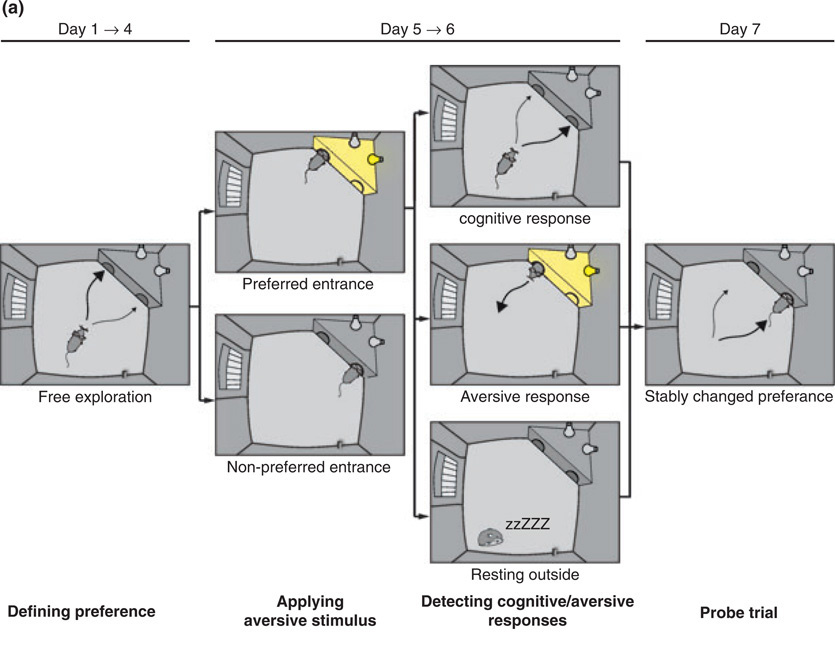
During the first 4 days the mouse could enter freely in the shelter. On day 4, the preferred (most used) entrance was detected by the system. On days 5 and 6, the mouse was sanctioned by a bright light (500 lx) when using the preferred entrance but not the other one. The last half day no entrance was sanctioned anymore.
Material and Methods
Mouse Model and Housing
Eight inbred strains were used: 129S1/SvImJ, A/J, BALB/C, C3H/HeJ, C57BL/6J, DBA/2J, FVB/N and NOD/LtJ. All male (age: 7 to 18 weeks), housed under 12-hr dark-light cycle, water and food ad libitum. Mice had minimum one week of acclimation to the facility before being individually housed in PhenoTyper cages for seven days.
All experimental procedures were approved by the national animal research committee and complied with the European Council Directive.
PhenoTyper
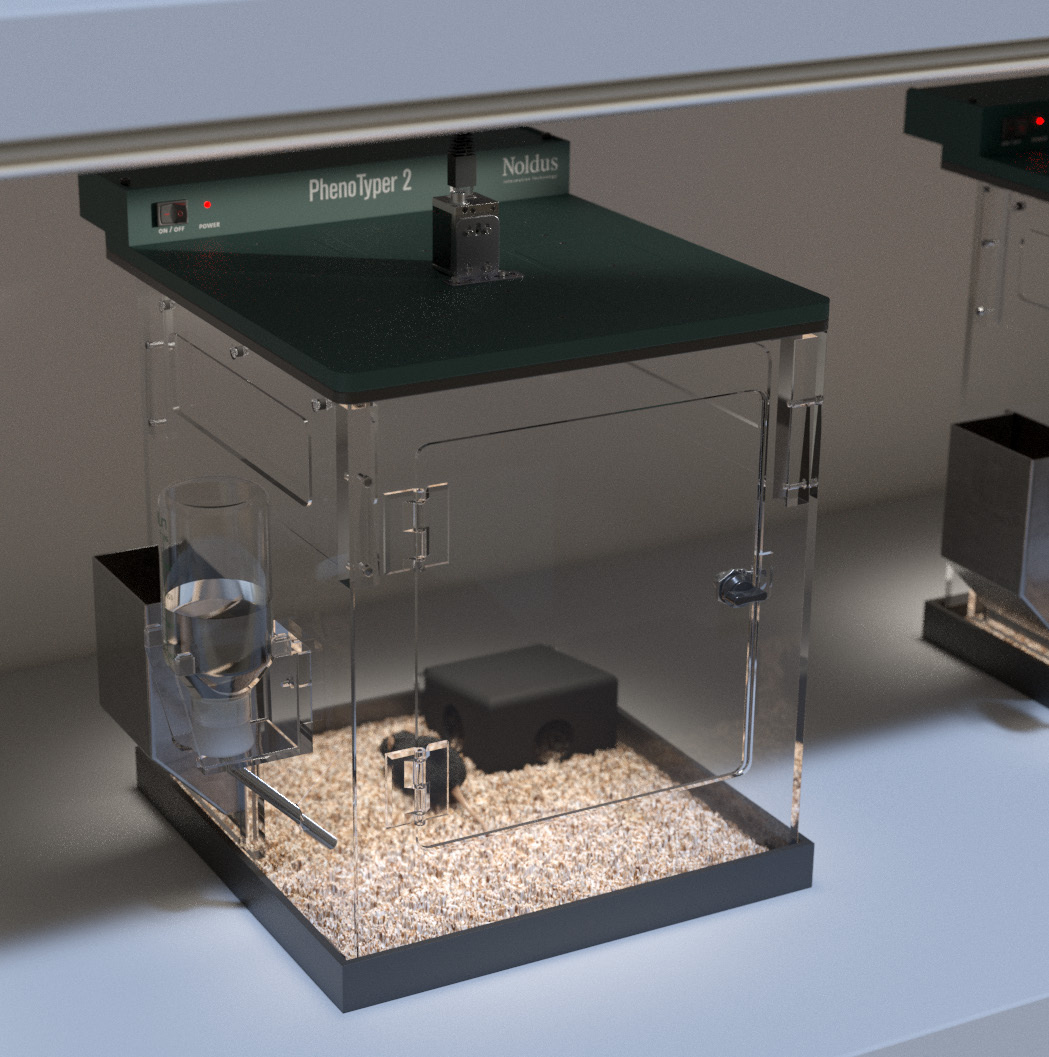
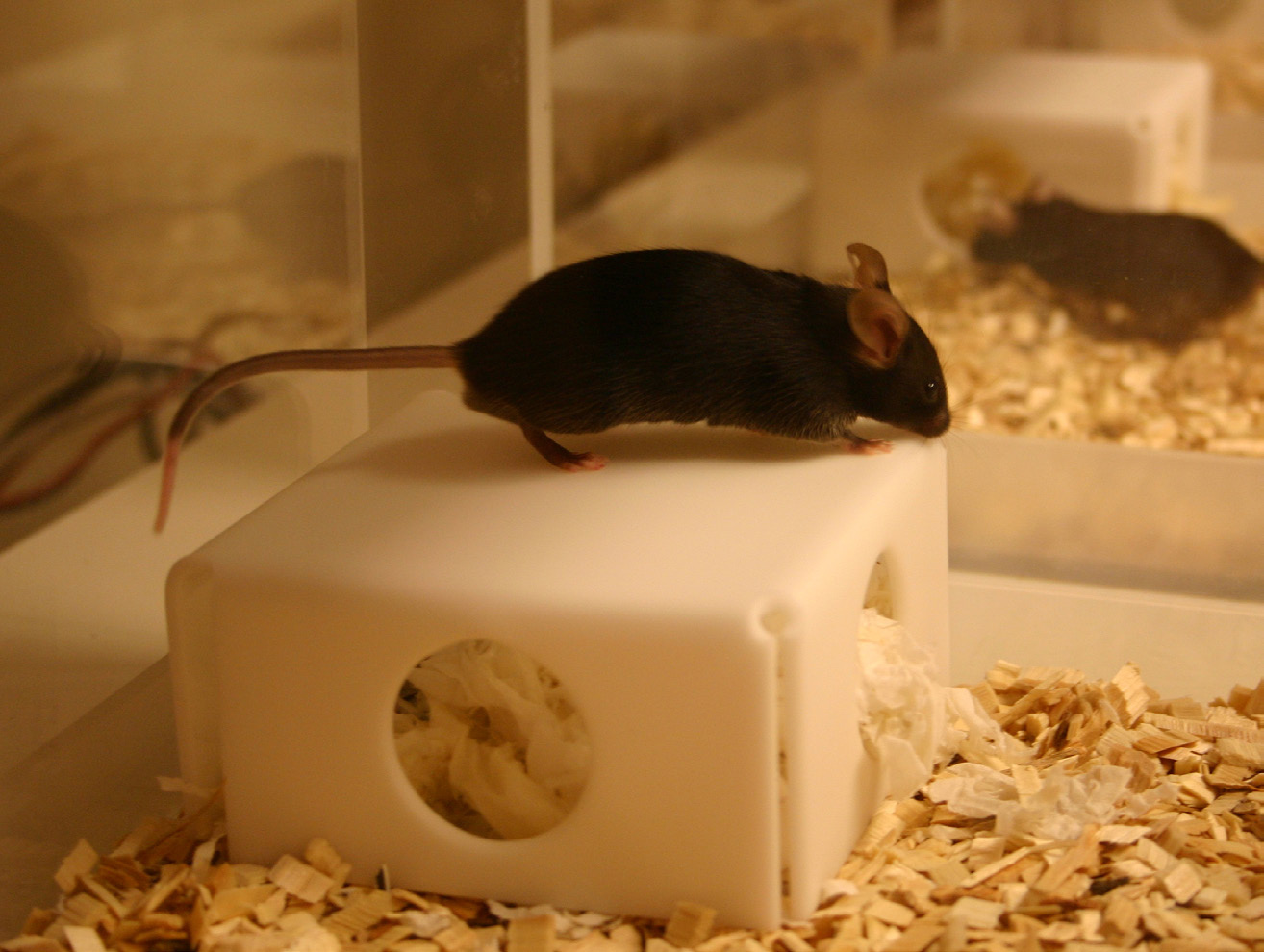
The PhenoTyper (L=30 x W=30 x H=35 cm) cage contains a feeder, a water bottle and a shelter (H=10 Hyp=9 cm, non-transparent) fixed in one of the corners. Two white LEDs in the shelter provide the aversive light stimulus.
Continuous activity was video-tracked in the home cage (PhenoTyper model 3000). EthoVision XT was used for the high-throughput screen and analysis.
Parameters used for analysis:
- Frequency of entries in each entrance of the shelter
- Distance moved
- Time spent in the shelter, in total for the 6.5 days
For more information on the algorithms used see the EthoVision XT manual.
Results and Discussion
Findings
Studying the avoidance behavior of eight inbred strains revealed specific genotypic differences in the activity, shelter visits pattern and preference development. Upon introduction of the aversive stimulus, most genotypes decreased their entries via the preferred entrance.
To describe this response (combining recognition and active avoidance of the sanctioned entrance), we calculated the preference index (fraction of the preferred entrance over the total). 129S1, DBA and C57 mice showed the strongest avoidance learning followed by BALB, NOD and A/J. As expected, visually impaired FVB and C3H mice show no learning.
Discussion
The present paradigm is an important new addition to existing paradigms, since it uses a mild aversive stimulus, runs without human interference and derives the cognitive response from the ratio of preferred entries excluding confounding effects of general activity.
The current data revealed several striking new features in complex adaptive behavioral response of mice that can be efficiently analyzed and visualized even in large cohorts of mice. Different genotypes exhibit marked and quantitative differences in distinct aspects of this behavioral response.
How PhenoTyper Can Enable Your Research
PhenoTyper is the ideal environment for a great variety of behavioral tests. It provides a constant, stress-free way to measure behavior and activity. This will enable you to obtain data more easily and of a higher quality. Together with EthoVision XT, you can fully program your experiment allowing you to save time setting up and performing your tests.
References
- Hurst, J. L.; West, R. S. (2010). Taming anxiety in laboratory mice. Nat. Methods, 7, 825-826.
- Crawley, J. N. et al. (1997). Behavioral phenotypes of inbred mouse strains: implications and recommendations for molecular studies. Psychopharmacology (Berl.), 132, 107-124.
- Stiedl, O. et al. (1999). Strain and substrain differences in context- and tone-dependent fear conditioning of inbred mice. Behav. Brain Res., 104, 1-12.
- Goulding, E. H. et al. (2008). A robust automated system elucidates mouse home cage behavioral structure. Proc. Natl. Acad. Sci., 105, 20575-20582.
- Jhuang, H. et al. (2010). Automated homecage behavioural phenotyping of mice. Nat. Commun., 1, doi:10.1038/ncomms1064.
- Heer, R.C. de et al. (2008). Learning (in) the PhenoTyper: an integrative approach to conducting cognitive behavioural challenges in a home cage environment. Proceedings of Measuring Behavior 2008, 6th International Conference on Methods and Techniques in Behavioral Research (Maastricht, The Netherlands, 26-29 August 2008), 57.
Download the original PDF: EthoVision XT - case study - mice avoidance learning (PDF)