For decades, autism research has focused on describing behaviors and identifying diagnostic patterns. But a new generation of studies is moving beyond description toward measurement, precision, and context.
Understanding autism through new lenses
Across recent publications, a shared theme is emerging: researchers are combining behavioral science with technology to observe communication, emotion, and learning as they naturally unfold. This shift isn't about replacing human insight with machines; it's about using smarter tools to see more clearly what has always been there.
Measuring what we couldn't see before
Traditional assessments rely on structured observation and caregiver reports. These methods remain essential, yet they sometimes miss the earliest, most subtle signs of how communication begins and develops. That gap inspired Choi-Tucci et al. (2025) to develop the Intentional Communication Coding Scale — a tool that quantifies how infants purposefully use gaze, vocalization, and gesture.
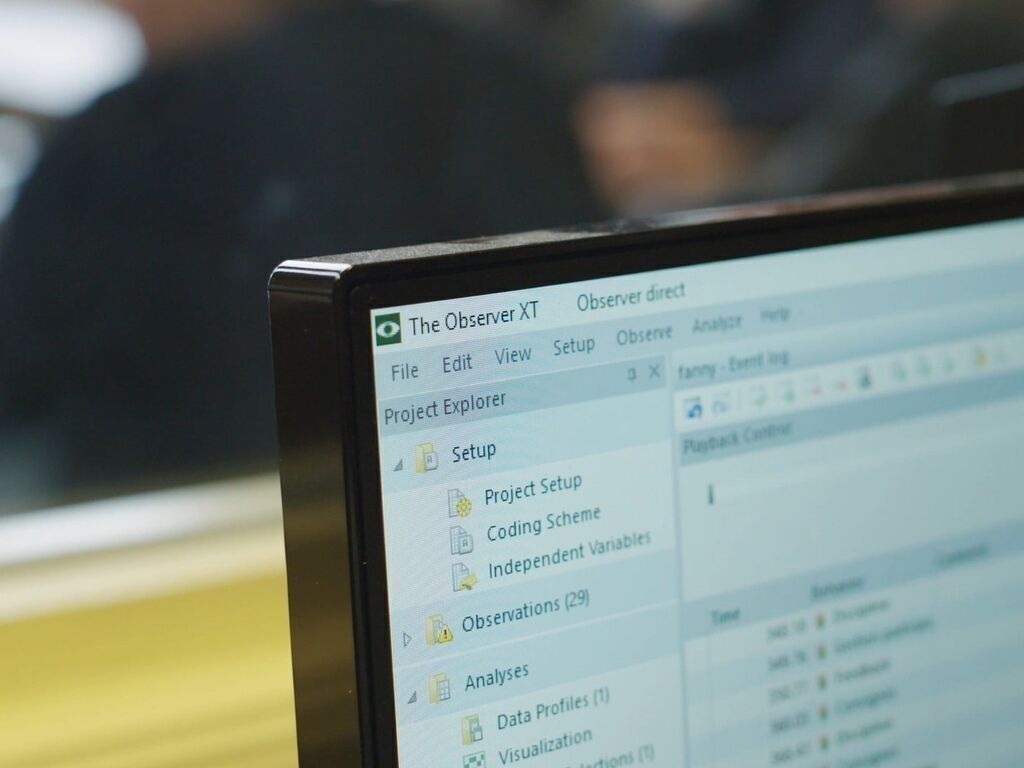
To do so, the team used The Observer XT, a software platform for behavioral coding and analysis.
By annotating caregiver–infant videos frame by frame, the researchers could capture not only what behaviors occurred but how and when they were directed toward another person. For instance, when a caregiver asked, "What does the monkey say?" one child looked up and made a playful "hee-hee-hee" sound. A small act that clearly showed awareness of the other person.
This level of detail made it possible to study intentionality — a subtle but crucial aspect of early social communication — with objectivity and reproducibility.
The result: a coding system that turns natural interaction into structured, quantifiable data, helping researchers and clinicians detect meaningful developmental patterns earlier than ever before.
FREE TRIAL
Try The Observer XT yourself!
Request a free trial and see for yourself how easy behavioral research can be!
- Work faster
- Reduce costs
- Get better data
Get your Free trial
science
When behavior speaks through data
Another study, by Bahrami Rad et al. (2025), took this approach further. Their team used wearable sensors to record physiological signals such as muscle activity, electrodermal activity, and skin temperature in individuals with multiple disabilities and autism who displayed challenging behaviors.
Using The Observer XT, the researchers carefully coded each behavior on video and linked it to the data from the wearable sensors. This allowed them to see, second by second, how changes in movement or body signals, such as increased arousal, connected to specific emotions or behaviors.
The insight was striking: movement patterns were often the earliest and strongest indicators of stress or agitation. These findings point to the potential of predictive modeling — a system that could warn caregivers before behavior escalates, for example, into self-injurious behavior.
Here, The Observer XT served as the backbone for data synchronization, ensuring that physiological measurements were grounded in behavioral context. The result is a rich, multi-layered understanding of emotional regulation.
Reading emotions with precision
While observation and physiology reveal what people do, understanding how they feel requires another layer of analysis.
In his study (2025), Erkan Kurnaz explored Video Self-Modeling (VSM) — an instructional technique in which learners watch short videos of themselves performing a task successfully. This approach builds on the idea that seeing one's own success can strengthen self-confidence, motivation, and behavioral learning.
VSM has long been used in behavioral and special education research to help children with autism develop social, communication, and learning skills. It combines two effective elements:
- Self-observation: learners see their own correct behavior, which reinforces the desired skill;
- Positive modeling: the model (the learner) is inherently familiar and predictable, which reduces anxiety and supports focus.
In this study, VSM was applied to teaching unplugged coding skills — activities that introduce the logic of programming without using computers. Children learned the basics of sequencing, loops, and conditional reasoning through hands-on materials such as cards, puzzles, and movement games. These exercises help children think like programmers, but in a tactile, visual, and concrete way that suits many learners with autism.
Validating engagement with FaceReader
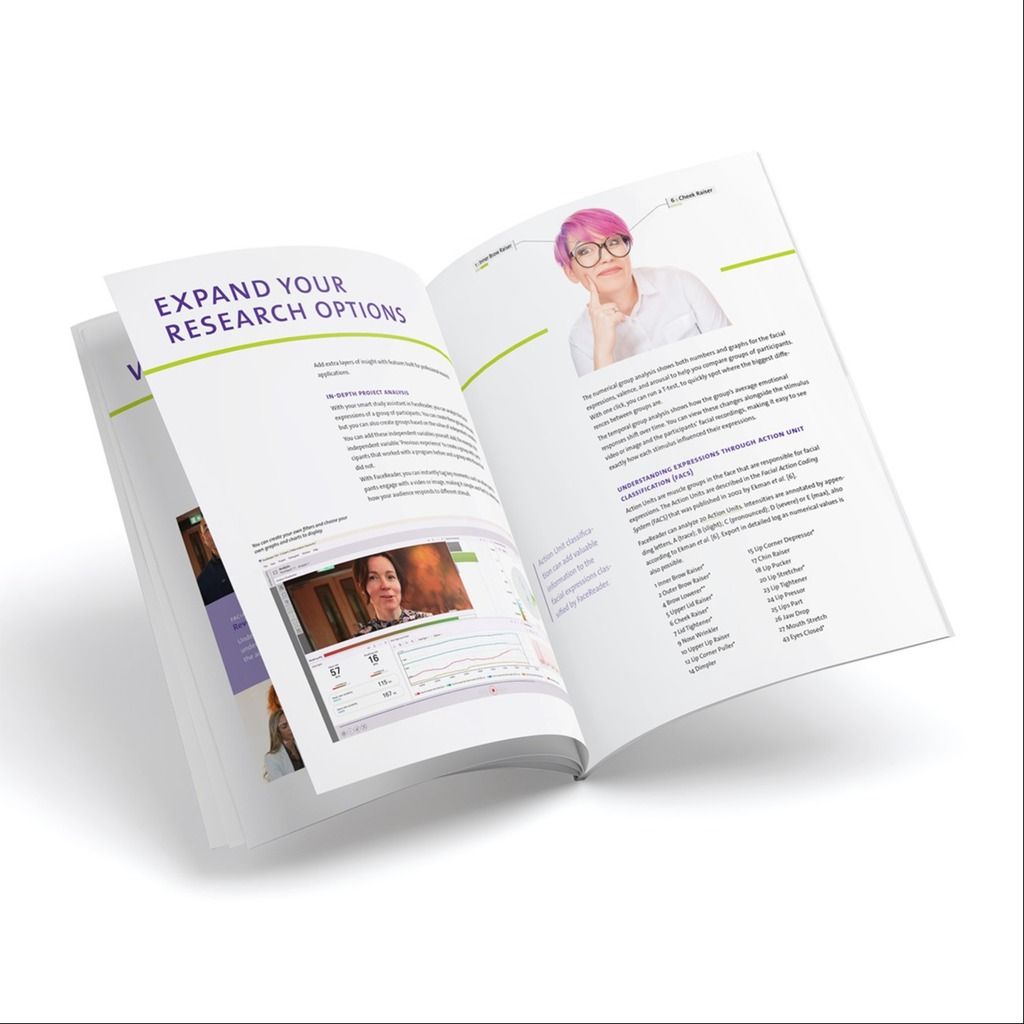
Before implementing the VSM intervention, the research team wanted to verify that participants were comfortable watching their own recorded videos. To do this, they used FaceReader to analyze facial expressions while the children viewed short clips of themselves compared with blank-screen videos.
FaceReader automatically detected emotions such as happiness, sadness, and surprise, providing objective data about each child's affective response. The results showed that the children displayed more positive facial expressions when watching their own successful performances, confirming that they enjoyed and engaged with the process.
This validation step mattered: it demonstrated that video self-modeling was not only feasible but emotionally motivating. By combining VSM with automated emotion analysis, the study provided a clear example of how technology can make both learning and emotional engagement measurable — and visible — in autism education.
FREE WHITE PAPER
FaceReader methodology
Download the free FaceReader methodology note to learn more about facial expression analysis theory.
- How FaceReader works
- More about the calibration
- Insight in quality of analysis & output
Submit to download
download
Research grounded in real life
A defining feature of these studies is their ecological validity, meaning that the research takes place in real-life environments, such as homes, classrooms, or everyday activities, instead of controlled lab settings.
- Choi-Tucci's study observed spontaneous caregiver–infant play.
- Bahrami Rad's work took place in classrooms and residential environments.
- Kurnaz's intervention happened during authentic learning sessions.
In each case, Noldus tools enabled rigorous data collection without disrupting natural interaction. The Observer XT offered precise timing and annotation, while FaceReader added automated emotional analysis from unstructured video. Together, they allowed researchers to preserve realism and maintain scientific precision.
This combination of natural context and objective data marks an important methodological advance: autism research that is both realistic and reproducible.
A holistic shift in autism research
Together, these studies highlight an important evolution: autism research is becoming more multimodal, quantitative, and responsive to real-world complexity.
Three broader shifts stand out:
-
1.
From traits to processes – Instead of focusing only on diagnostic features, researchers are studying how communication, stress, or learning unfolds over time. Autism is seen not as a static condition but as a dynamic interaction between the individual and their environment.
-
2.
From clinical to technological precision – Tools such as wearable sensors, behavioral coding systems, and automated video analysis add a layer of objectivity and reproducibility. They allow teams to detect subtle changes that humans might miss — especially useful for early intervention and progress monitoring.
-
3.
From observation to integration – By combining video coding, physiological data, and emotion analytics, researchers can create a multilayered picture of each participant's experience. The result is not just more data, but richer, context-aware understanding.
Crucially, technology should extend, not replace, human understanding. The Observer XT and FaceReader are powerful because they extend human expertise. Behind every data point is a person whose emotions and behaviors deserve empathy as much as analysis.
Looking ahead: from data to understanding
What ties these studies together is a shift from seeing behavior to understanding experience. By using Noldus tools to synchronize observation, emotion, and environment, researchers can now trace how learning, communication, and stress interact in real time.
By combining Noldus tools with wearable sensing and educational innovation, researchers are now able to:
- Measure communicative intent before language develops.
- Detect early signs of distress through synchronized movement and physiology.
- Quantify emotional engagement in learning through facial expression analysis.
When behavioral science and technology come together, autism research becomes more connected to everyday life. It allows us to ask richer questions. Not only "what does autism look like?" but "how does it feel, develop, and adapt?"
References
- Bahrami Rad, A.; Villavincencio, T.; Kiarashi, Y.; Anderson, C.; Foster, J.; Kwon, H.; Hamlin, T.; Lantz, J. & Clifford, G.D. (2025). From motion to emotion: exploring challenging behaviors in autism spectrum disorder through analysis of wearable physiology and movement. Physiological Measurement, 46. https://doi.org/10.1088/1361-6579/ada51b
- Choi-Tucci, E.; Sideris, J.; Holland C.; Baranek, G.T. & Watson, L.R. (2025). Measuring Intentional Communication in Infants at Elevated Likelihood of Autism: Validity, Reliability, and Responsiveness of a Novel Coding Scale. Journal of Speech, Language, and Hearing Research, 68, 1151-1160. https://doi.org/10.1044/2024_JSLHR-23-00787
- Kurnaz, E. (2025). Effectiveness of Video Self-Modeling in Teaching Unplugged Coding Skills to Children with Autism Spectrum Disorders. Behavioral sciences, 15(3), 272. https://doi.org/10.3390/bs15030272