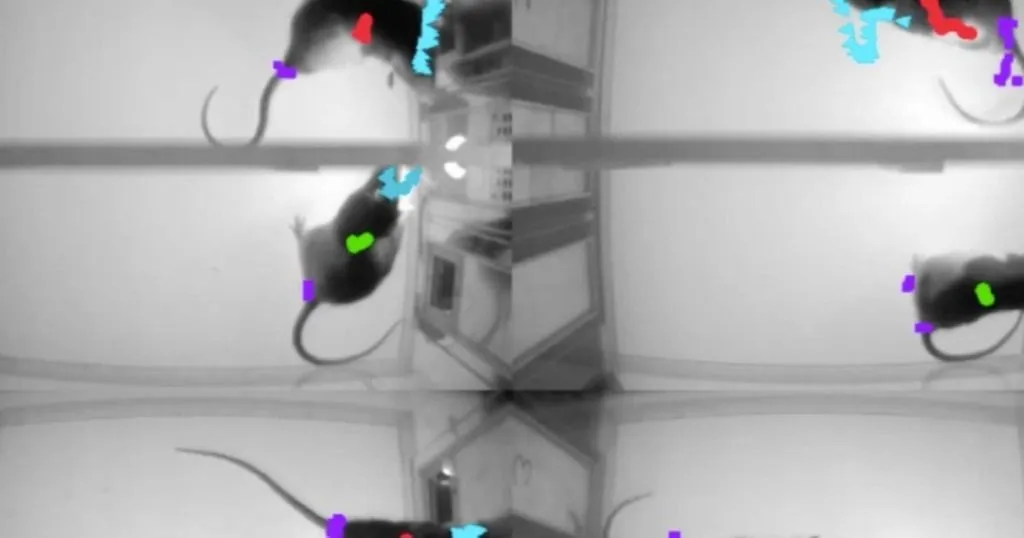
5 blogs on why you should use video tracking in behavioral research
In this blogpost you can find an overview of our top 5 favorite blogs on why you should use video tracking in your behavioral research.
Read More arrow_forwardCompare EthoVision and DeepLabCut for animal behavior tracking. Learn where each tool excels, when to use both, and how to evaluate newer entrants.
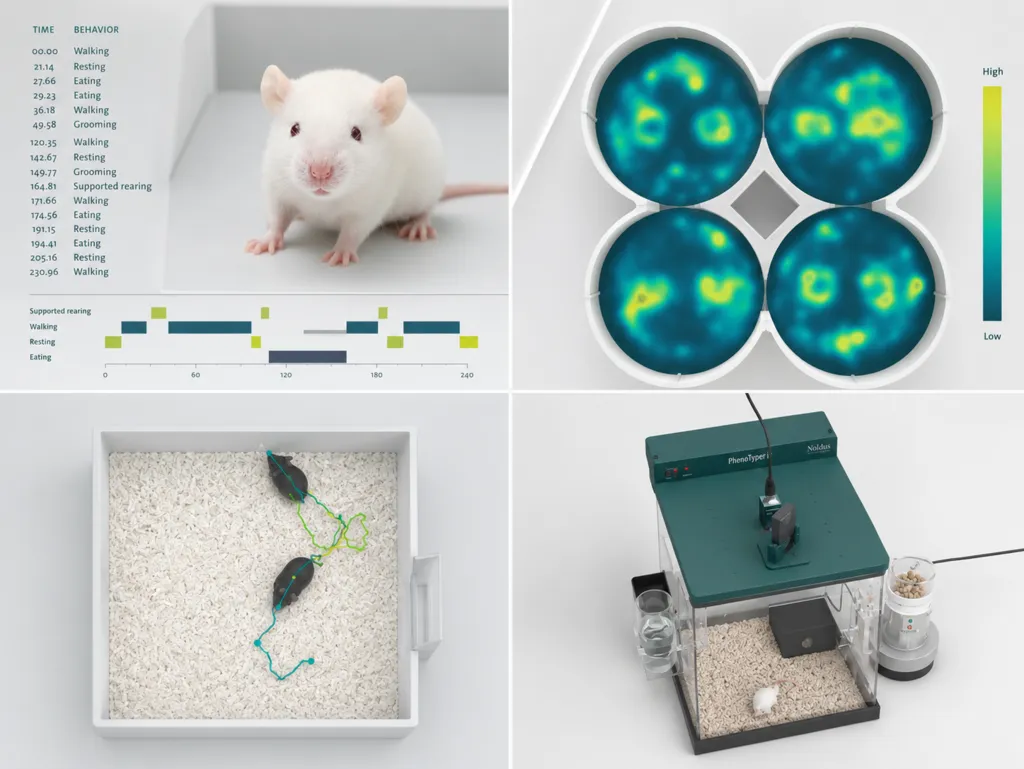
If you track animal behavior from video, you have probably wondered where EthoVision ends and where open-source tools like DeepLabCut begin. The honest answer: they were built to solve different problems, and the most capable labs increasingly use both.
This guide lays out what each tool does best, where they overlap, and how to decide which belongs in your research. Stay till the end to look at a newer category of marketing-led entrants that claim to replace both, and why that claim deserves scrutiny.
EthoVision video tracking software is a validated, end-to-end behavioral research platform. It handles acquisition, tracking, zone and event detection, analysis, and export inside one controlled environment. It has been refined for over three decades of use in behavioral neuroscience. The design goal is a reliable result that any reviewer will accept, produced by a researcher who does not need to write code.
DeepLabCut is an open-source, deep-learning framework for markerless pose estimation. It is an outstanding piece of science, widely cited and genuinely transformative for questions that depend on fine-grained multi-body-point tracking. The design goal is flexibility: you define the body parts, you train the network, and you get coordinates for whatever anatomy your study cares about.
But this isn't "Maslow's Hammer" and you don't have to treat everything as if it were a nail. The reality is that neither tool is a worse version or replacement of the other. An open field test of locomotion or elevated plus maze assay of anxiety and a study of limb kinematics during a reaching task are different problems, and they require different tools, just as a carpenter might need a drill, screwdriver, and hammer.
EthoVision has evolved steadily, and the current version is a long way from early center-point tracking. As of 2026, EthoVision 19 combines classic detection methods with deep-learning-based tracking, so you get robust body-point and nose-tail-center detection without writing or training anything yourself. Multi-animal tracking with identity preservation means you can study socially interacting animals in the same arena without markers, and the platform scales to high-throughput designs across many arenas at once. Integrations with hardware for stimulus control, and modules for behavior recognition extend it well beyond a position tracker. If your mental picture of EthoVision is "it just tracks where the center of the animal is," that has not been the whole story for a long time.
DeepLabCut earns its place when your science depends on detailed pose rather than position. It is worth using when:
DeepLabCut has evolved too, and it is worth being accurate about that. As of 2026, version 3.0 introduced a PyTorch backend with performance gains and a more developer-friendly architecture. The Model Zoo now offers SuperAnimal foundation models, such as SuperAnimal-Quadruped and SuperAnimal-TopViewMouse, that can run without training a model from scratch. Multi-animal pose estimation, identification, and tracking have been supported since version 2.2 and were strengthened in 3.0. If you last looked at DeepLabCut a few years ago, the "you must train everything yourself" picture is no longer the whole story.
Because DeepLabCut is more capable than it used to be, the sharper way to think about the tradeoff is not "how hard is it to install." Instead, it is: how many hours does it take to train a model, validate it, and reproduce the same result across collaborators, reviewers, or animal cohorts?
Key insight
The question isn't how hard it is to install. It's how many hours it takes to get the same answer twice.
In practice, each of those steps is real work. Training means labeling body points across hundreds of frames by hand, configuring the network, running the training, and iterating when the early results are poor. Validation means checking the model's predictions against ground truth, measuring error, and confirming it holds up on animals, lighting, and arenas it was not trained on, not just the clips you happened to label. Reproduction is the step labs underestimate most: a collaborator must recreate your software environment, model version, and configuration closely enough to get the same numbers from the same video, and a reviewer must trust that they would.
A single trained model can represent days to weeks of skilled effort before it produces one publishable result, and every one of those choices is a place where two labs can quietly diverge.
Every choice that gives an open-source pipeline its flexibility also adds a place where two labs can diverge: backend versions, model architecture, the choice between a foundation model and a fine-tuned one, multi-animal configuration, annotation conventions, and training data. None of this is a criticism of the science. It is the nature of a configurable research framework. But it means the burden shifts from "getting it running" to "getting the same answer twice," which is exactly what journal and grant reviewers increasingly note and push back on.
EthoVision's value in that frame is not only ease of use. It is that a validated, controlled environment makes a result straightforward to defend and reproduce. When your collaborator across the country opens the same project, they see the same settings producing the same numbers. EthoVision has been validated against a ground truth and with the Quality Assurance functionality included in the Premium package, it supports Code of Federal Regulations Title 21, Part 58 (GLP) compliance.
Why this matters
With EthoVision, reproducibility is not extra work. The same validated settings produce the same numbers, whether the project is reopened next week or by a collaborator across the country.
These tools are not mutually exclusive and pairing them is often the strongest design. A common pattern: use EthoVision for validated, high-throughput position tracking, zone metrics, and the core readouts that carry your primary endpoints, and bring in DeepLabCut for a focused pose-estimation sub-analysis where detailed body-point data adds a layer the position track cannot. You get reproducible primary measures and the fine-grained detail where it earns its cost.
| If your priority is... | Reach for... |
|---|---|
| Fast, validated, citable results with minimal setup | check_circleEthoVision |
| High-throughput screening across many arenas or animals | check_circleEthoVision |
| Custom body-point or kinematic pose analysis | DeepLabCut |
| Reproducibility and reviewer-proof primary endpoints | check_circleEthoVision |
| Validated primary measures plus a detailed pose sub-study | check_circleBoth, in one pipeline |
| Minimal staff knowledge of coding or programming | check_circleEthoVision |
Recently, a new wave of entrants has begun marketing itself around the same keywords researchers use to evaluate established tools, positioning their platforms as combining DeepLabCut's precision with EthoVision's ease of use, and publishing self-generated rankings that place themselves at the top of the field. It is worth approaching that kind of self-ranking with the same skepticism you would apply to any other claim in your field. A few things to weigh:
The point is not that no new tool can ever be good. It is that the burden of proof sits with the tool making the claim, and in behavioral research that proof is measured in independent validation and reproducible published results, not in self-assigned rankings.
Bottom line
When a tool ranks itself first and claims to be the best of both worlds, ask for the one thing that actually settles it: an independent record of published research that used it.
If your work rewards validated, reproducible, high-throughput tracking that gets to a publishable result quickly, EthoVision animal behavior tracking software is built for exactly that.
If your science depends on detailed pose, DeepLabCut markerless pose estimation software is a superb complement, and the two work well together.
If a newcomer promises to replace both, ask it for the validation record before you trust it with your data.
Want to know if EthoVision will work for you? Check out detailed specs for effortless setup.
Need publication examples? You can find them here. Want to see a detailed comparison of the available video tracking solutions? See our comparison table here.
Finally, you can get a free trial and try it for yourself.
In this blogpost you can find an overview of our top 5 favorite blogs on why you should use video tracking in your behavioral research.
Read More arrow_forward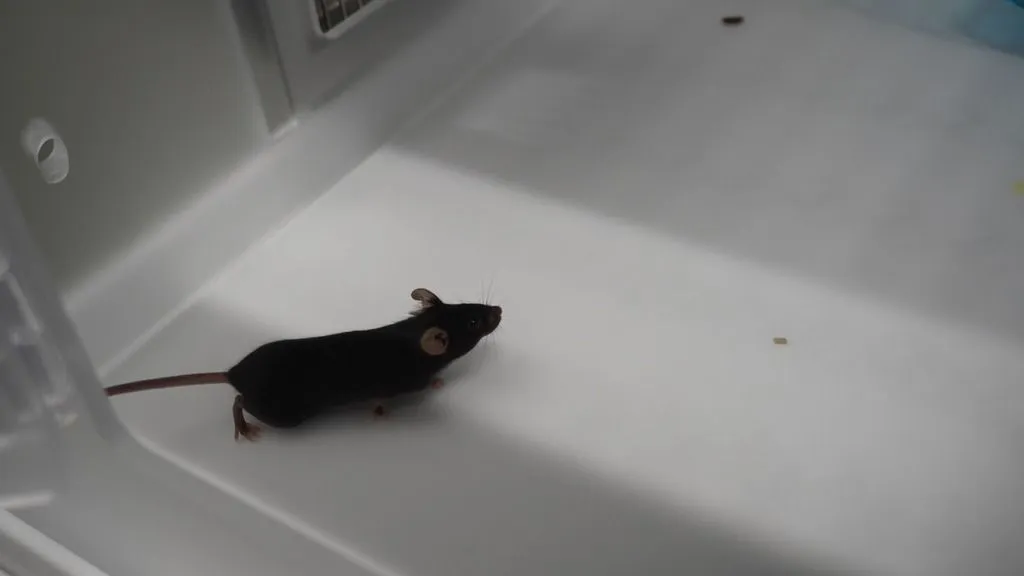
What is the best lighting for my experiment? How do I clean my system? Can I use any bedding for my set up? These are all valid questions when you are starting out with PhenoTyper. In this blog we will cover some of the most asked questions.
Read More arrow_forward
In this last post in the series, Dr William Gerin gives advice how to build a realistic budget, navigate new NIH policies, and write clearly and engagingly so reviewers understand and support your research.
Read More arrow_forwardWe'll get back to you shortly.
Please correct the following errors:
We look forward to seeing you at the NoldusViso launch event.
Please correct the following errors: