From subjective to objective facial data
If you want to understand emotion, engagement, or subtle social signals, you need a method you can trust. FACS gives you a proven, scientific way to describe facial behavior objectively and consistently.
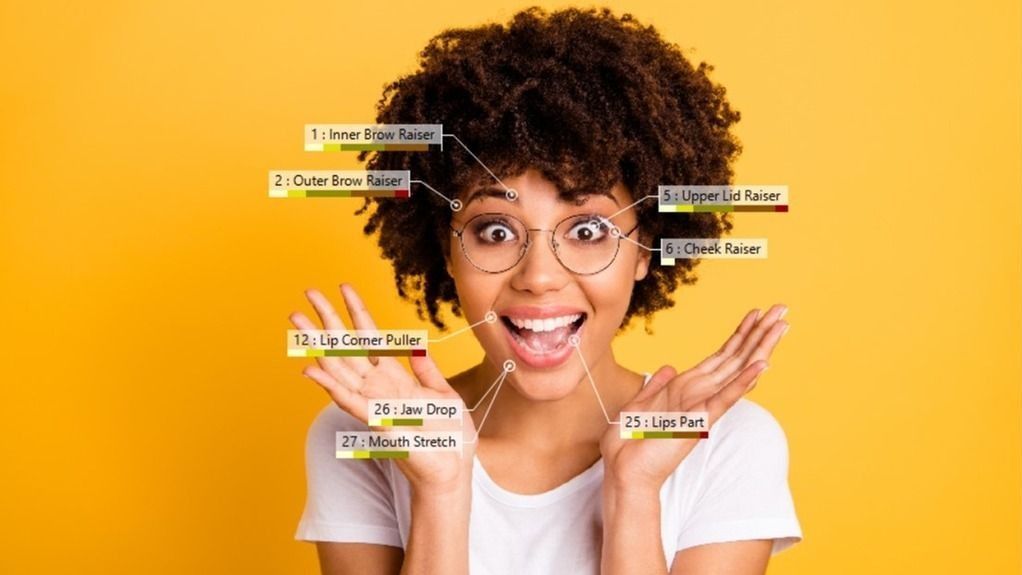
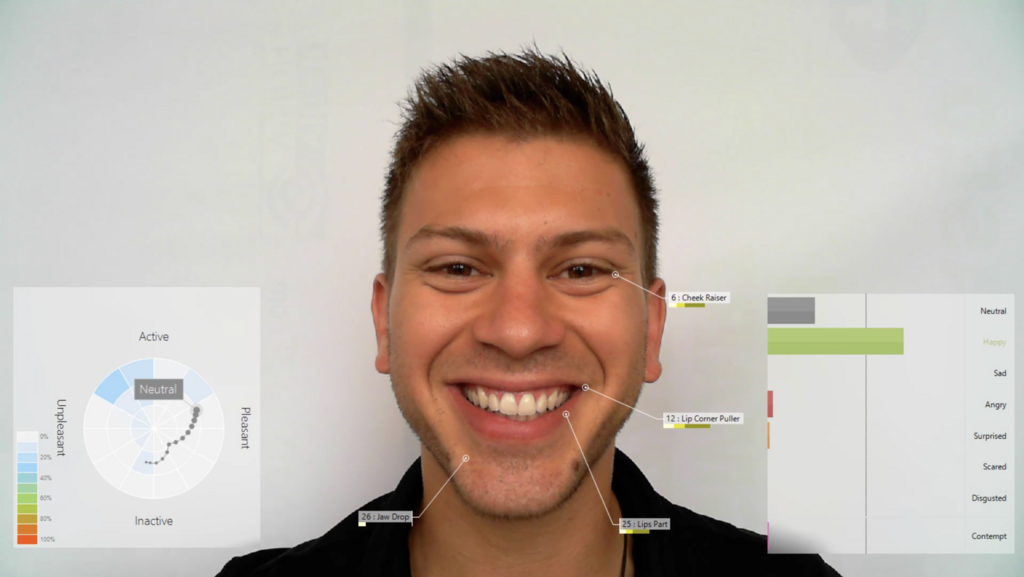
The Facial Action Coding System (FACS) is a scientific framework for describing facial movements. It was developed by Paul Ekman and Wallace Friesen, whose work laid the foundation for modern facial expression research. Instead of categorizing emotional expressions, FACS breaks facial expressions down into Action Units (AUs), which are specific, observable muscle movements such as raising the eyebrows or tightening the lips. The level of activation of each Action Unit is specified on a 5-level intensity scale from A (trace - barely visible) to E (maximum - the most extreme form of the movement). This allows researchers to capture not just which muscles move, but also how much. Each expression can be described by a unique combination of these Action Units. That makes facial behavior measurable, comparable, and independent of interpretation. Below you can see the 20 Action Units from the Facial Action Coding Scheme (FACS) offered in FaceReader as well as some frequently occurring or difficult Action Unit combinations. Some images have been zoomed in on the area of interest to explicitly show what muscle movement corresponds to the specific Action Unit. Contributes to sadness, surprise, and fear. Muscular basis: frontalis (pars medialis). Contributes to surprise and fear. Muscular basis: frontalis (pars lateralis). Contributes to sadness, fear, and anger. Muscular basis: depressor glabellae, depressor supercilii, corrugator supercilii. Contributes to surprise, fear, and anger. Muscular basis: levator palpebrae superioris, superior tarsal muscle. Contributes to happiness. Muscular basis: orbicularis oculi (pars orbitalis). Contributes to fear and anger. Muscular basis: orbicularis oculi (pars palpebralis). Contributes to disgust. Muscular basis: levator labii superioris alaeque nasi. Muscular basis: levator labii superioris, caput infraorbitalis. Contributes to happiness and contempt. Muscular basis: zygomaticus major. Contributes to contempt and boredom. Muscular basis: buccinator. Contributes to sadness and disgust. Muscular basis: depressor anguli oris. Contributes to the affective attitudes interest and confusion. The underlying facial muscle is mentalis. The underlying facial muscles are incisivii labii superioris and incisivii labii inferioris. Contributes to the emotion fear. The underlying facial muscle is risorius w/ platysma. Contributes to the emotion anger, and to the affective attitudes confusion and boredom. Muscular basis: orbicularis oris. Contributes to the affective attitude boredom. The underlying facial muscle is orbicularis oris. The muscular basis consists of depressor labii inferioris, or relaxation of mentalis or orbicularis oris. Contributes to the emotions surprise and fear. Muscular basis: masseter; relaxed temporalis and internal pterygoid. The underlying facial muscles are pterygoids and digastric. Contributes to the affective attitude boredom. The muscular basis consists of relaxation of Levator palpebrae superioris. Contributes to the emotions fear and can be recognized by the wavy pattern of the wrinkles across the forehead. Contributes to the emotion surprise and can be recognized by a smooth line formed by the wrinkles across the forehead. Contributes to sadness. Recognizable by a wavy pattern of the wrinkles in the center of the forehead. Eye-brows come together and up. Contributes to the emotion anger. Contributes to happiness. Notice the wrinkles around the eyes caused by cheek raising, also known as the "Duchenne Marker". Contributes to the emotion disgust. When AU 10 is activated intensely, it causes the lips to part as the upper lip raises. Often confused as solely AU 18. Notice the lips almost appear to be pulled by a single string outward (AU 18) and then tightened (AU 23). The AUs marking lip movements are often the hardest to code. The lips are being pushed together (AU 24) and tightened (AU 23). It takes humans several hundred hours to become an expert in recognizing these movements. Facial Action Coding System software, like FaceReader, automatically detects and quantifies Action Units from video, frame by frame. It brings FACS into practice, removes practical barriers, and allows you to define custom expressions by combining Action Units in ways that match your research goals. That means you can: Quick overview FaceReader This short info sheet gives you a clear look at what FaceReader can do: analyze behavior using just a webcam, with no hassle. You'll find an overview of key features like emotion detection, gaze tracking, and heart rate analysis, along with examples of how it's used in research and education. A great starting point if you want to explore behavioral tools or expand your research methods.
FACS and FaceReader in practice
The publications and blog posts below include references on FACS, the ADFES dataset, and examples from FaceReader users, offering context for how facial expression analysis is used in research. Ekman, P., Friesen, W. V. & Hager, J.C. (2002). Facial Action Coding System. Manual and Investigator's Guide, Salt Lake City: Research Nexus. Lewinski, P.; Fransen, M. L.; Tan, E.S.H. (2014). Predicting Advertising Effectiveness by Facial Expressions in Response to Amusing Persuasive Stimuli. Journal of Neuroscience, Psychology, and Economics, 7, 1-14. https://doi.org/10.1037/npe0000012 Van der Schalk, J., Hawk, S. T., Fischer, A. H., & Doosje, B. J. (2011). Moving faces, looking places: The Amsterdam Dynamic Facial Expressions Set (ADFES), Emotion. https://doi.org/10.1037/a0023853 How does perception of brand authenticity affect ad performance? Analysis of facial expressions of emotions in children Why you should use custom expressions in your facial expression analysis Smile like you mean it Creating a custom expression for engagement: a validation study with FaceReader Boobani, B.; Kalnina, Z.; Glaskova-Kuzmina, T. et al. (2025). Utilizing Facial Emotion Analysis with FaceReader to Evaluate the Effects of Outdoor Activities on Preschoolers' Basic Emotions: A Pilot Study in e-Health. International Journal of Online and Biomedical Engineering, 21(07), 61-75. https://doi.org/10.3991/ijoe.v21i07.54291 Mshael, E.; Stillhart, A.; Rodrigues Leles, C. & Srinivasan, M. (2025). Application of automated face coding (AFC) in older adults: A pilot study. Journal of Dentistry, 153. https://doi.org/10.1016/j.jdent.2025.105555 Dimitra, S.; Ioanna, Y. & Georgois, T. (2025). Neuromarketing and Health Marketing Synergies: A Protection Motivation Theory Approach to Breast Cancer Screening Advertising. Information, 16, 715. https://doi.org/10.3390/info16090715 Curious about this product but not ready to decide yet? Just let us know what you need: more information, a price quote, a free trial, a demo, or an online meeting with one of our specialists. We're here to help you with the next steps to finding your solution. We will get back to you within one business day.Facial Action Coding System (FACS)
Get more info
arrow_forward
What is FACS?

20 Action Units
AU 1. Inner Brow Raiser
AU 2. Outer Brow Raiser
AU 4. Brow Lowerer
AU 5. Upper Lid Raiser
AU 6. Cheek Raiser
AU 7. Lid Tightener
AU 9. Nose Wrinkler
AU 10. Upper Lip Raiser
AU 12. Lip Corner Puller
AU 14. Dimpler
AU 15. Lip Corner Depressor
AU 17. Chin Raiser
AU 18. Lip Pucker
AU 20. Lip Stretcher
AU 23. Lip Tightener
AU 24. Lip Pressor
AU 25. Lips Part
AU 26. Jaw Drop
AU 27. Mouth Stretch
AU 43. Eyes Closed
Combinations of Action Units
AU 1 - 2 - 4
AU 1 - 2
AU 1 - 4
AU 4 - 5
AU 6 - 12
AU 10 - 25
AU 18 - 23
AU 23 - 24
How does FaceReader help you work with FACS?

Download the info sheet
Publications & resources
For brands seeking to resonate with customers, being seen as authentic is vital. Using custom expressions in FaceReader, we explore how perception of brand authenticity relates to ad performance.
The study described in this guest blog post focuses on the facial expressions of emotions induced by affective stimuli in children aged between 7 and 14.
Using custom expressions in facial expression analysis can unlock a deeper understanding of human behavior. How can you use custom expressions in different fields of research?
Of all human expressions, a smile is the most universal. But can you tell which smile is real and which is false?
The concept engagement is gaining more and more attention. Many companies are looking for ways to increase consumer engagement. But, how do you know a consumer is feeling engaged?Want more info?
Thank you!