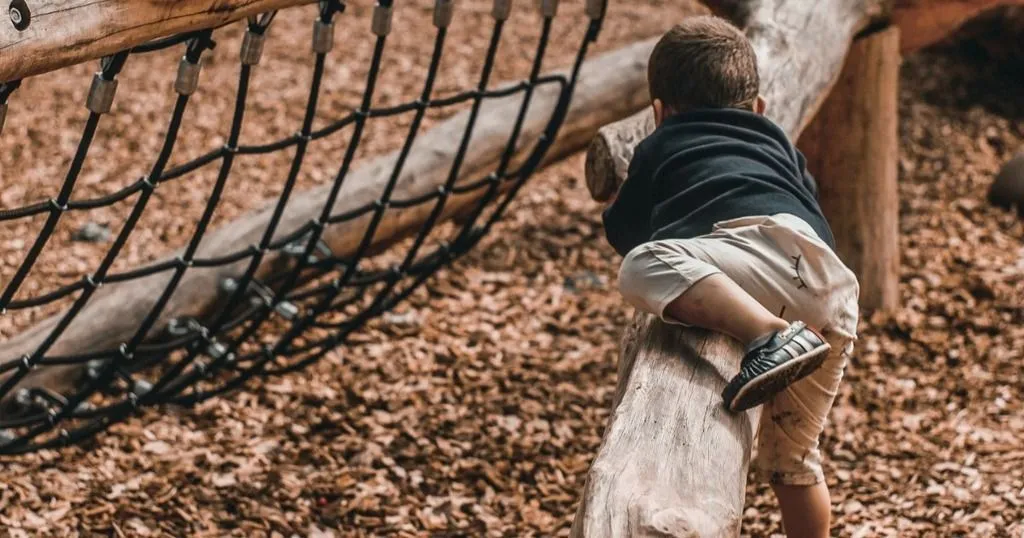
When I was little it was common to play outside, build a hut out of branches and leaves, find frogs in a ditch, climb walls that were just a little too high, and play a ball game with the neighbor children on the street in front of our houses. From time to time, we pushed the limits and looked for thrilling situations, which created healthy tension. We engaged in risky play.
Nowadays, my teenage children mostly watch YouTube, TikTok, or Netflix, and play on the PlayStation. Admittedly, this may say something about my parenting skills. However, it is also a trend of the present time.
FREE WHITE PAPER
Tools for infant studies
Learn more about the software tools available for infant studies.
- Capture behaviors with video
- Annotate behaviors accurately
- Unobtrusive emotion analysis
Get your copy instantly
arrow_forward
Risky play beneficial for children’s development
Over recent decades, children are left with fewer opportunities for free play, especially outdoors. Children spend more time indoor in sitting activities, and less time in outdoor play and vigorous physical activity.
However, children need feelings of exhilaration now and then. Research indicates that risky play and risk-taking activities may increase children’s physical activity, improve motor/physical competence, increase spatial and perceptual skills, and enhance their ability to assess and manage risk appropriately.
Engaging in risky play will be rewarded by experiencing feelings such as enjoyment, pride, achievement, and good self-esteem when children master new challenges. What exactly does risky play mean?
The connection of risky play to spaces and materials
Based on observations and interviews in Early Childhood Education and Care (ECEC) institutions and facilities such as daycare centers, kindergartens, and preschools, eight categories of risky play can be determined:
- play with great heights (e.g. climb trees or jump from high places)
- play with high speed (e.g. swing at high speed or roll down steep hills)
- play with dangerous tools (e.g. ropes, hammers or knives)
- play near dangerous elements (e.g. steep cliffs or deep water)
- rough-and-tumble play (e.g. play fighting or chase-and-catch play)
- play where children go exploring alone (e.g. no constant supervision)
- play with impact (e.g. crash their wheeled toys into the fence)
- vicarious play (e.g. observe other children taking risks)
For children that spend a large amount of time in ECEC institutions, the play environment is of great importance. Researchers have conducted several studies to discover, for example, the relationship between children’s play preferences and the physical environment (play environment) available.
The research team of Ellen Sandseter, of the Queen Maud University College of Early Childhood Education in Norway, addressed the question how risky play is connected to spaces and materials in the physical play environment.
Coding risky play behavior
Eighty children from ages of 3 to 5 years participated in the study. Following a strict protocol, each child’s free outdoor play was recorded in two-minute sequences, with a total of six sequences. The recordings at two data points (T1 in 2017 and T2 in 2018) eventually resulted in 935 video observations.
The researchers coded risky play behavior using The Observer XT, following to a coding scheme with the eight types of risk. In the further analysis, play with great heights, play with high speed, and rough-and-tumble play were analyzed in detail, in addition to the category of total risky play, which included all risky play categories. The appearance of the other categories were too low.
Play spaces (e.g. sandbox, open area, fixed play equipment such as swings) and play materials (e.g. sand, water, toys) were coded as a percentage of time for each observation.
Analyzing the video observations
After analyzing the data in The Observer XT, the researchers found that almost all children seemed to engage in risky play to some level. They showed this behavior on average 13% of the outdoor free playtime. Risky play mostly consisted of play with high speed and play in great heights, and some rough-and-tumble play, which all include movement and physical activity. Natural environments, such as areas with trees, bushes, grassy hills, and uneven surfaces, facilitated risky play.
It also became evident that children predictively engaged in risky play on play equipment designed for physical activity such as climbing, sliding, and balancing (e.g., climbing towers and slides) as well as wheeled toys that guaranteed high speed. Additionally, they created risky play themselves with tables and chairs, sheds, and toy storage buildings, which were not intended for play. Children seemed to climb anything that can be climbed.
FREE TRIAL
Try The Observer XT yourself!
Request a free trial and see for yourself how easy behavioral research can be!
- Work faster
- Reduce costs
- Get better data
Get your Free trial
arrow_forward
Encouraging challenging play behavior
This extensive dataset of observations allowed the researchers to quantify the various behaviors and conclude which risky behaviors occurred, with which toys or tools, in what spaces, and how often. These insights will help developmental psychologists, practitioners, and other stakeholders in balancing safety and healthy stimulation with challenges for behavioral development. And to design and equip children’s play environments in ways that give access to various spaces and materials that encourage challenging play.
Reference
Sandseter, E.B.H.; Sando, O.J.; Kleppe, R. (2021). Associations between Children’s Risky Play and ECEC Outdoor Play Spaces and Materials. International Journal of Environmental Research and Public Health, 18, 3354. https://doi.org/10.3390/ijerph18073354