
The emotions of people who think they’re nice
What does ‘nice’ actually mean in relation to psychological variables? And does it positively correlate with self-reported levels of health, happiness, and wellbeing?
Read More arrow_forwardMany researchers have turned towards using automated facial expression recognition software to better provide an objective assessment of emotions.
Emotions can be both a gift and a curse. They are what makes us human, and we all experience them – whether it is through the ability to feel love and happiness, or pain and suffering. In addition, they are difficult to hide. All emotions, whether they are suppressed or not, are likely to have a physical effect. However, studying emotions can be hard, since it is not often clear how to exactly interpret them.
For this reason, many researchers have turned towards using automated facial expression recognition software to better provide an objective assessment of emotions. Because human assessment of emotions has many limitations and biases, facial expression technology can be used to deliver a greater level of insight into behavior patterns.
This video shows FaceReader results.
Noldus' FaceReader software is one example of a tool that is specifically designed for this purpose, and is used in human behavior research for applications such as psychological research, usability studies, and advertising and consumer behavior.
The American psychologist Paul Ekman found that some facial expressions are universal, and can be reliably measured in different cultures. FaceReader bases its algorithms on these original basic expressions, and can automatically determine the presence and intensity of the following emotions: Happy, Sad, Angry, Surprised, Scared, Disgusted, and Neutral (no emotion). It can also analyze interest, boredom, and confusion, which are three commonly occurring affective attitudes.
The software works by following these consecutive steps:
Types of input sources commonly used with FaceReader include video analysis, live analysis using a webcam, and still images. Once classified, emotions can be represented as line and/or bar graphs as well as in a pie chart, which shows the percentage per emotion.
In addition, FaceReader can also calculate gaze direction, head orientation, and characteristics such as gender, and age.
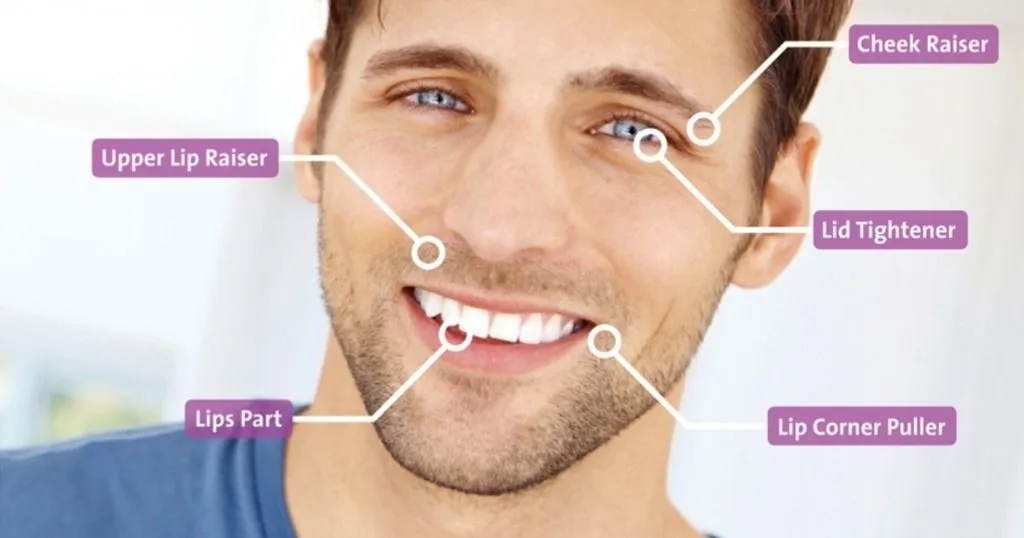
Automated facial coding can be further extended to an action unit level, according to the FACS (Facial Action Coding System). To backtrack a little, the FACS is a facial expression coding system meant for measuring facial expressions and describing all observable facial movement. The movements of individual facial muscles are broken down into specific action units. FaceReader's Action Unit Module is capable of analyzing 20 of these action units, including Cheek Raiser, Nose Wrinkler, and Dimpler.
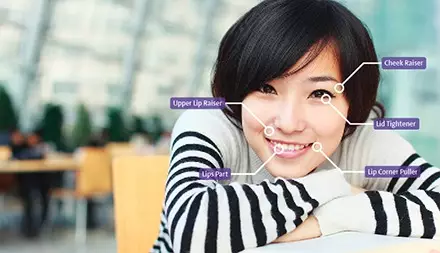
Action Units are responsible for facial expressions.
Because FaceReader can serve as an automated, non-intrusive measure of engagement, it can be used in many applications. Some notable examples of fields using facial expression research include:
For more information, please feel free to contact us to speak with a Sales Consultant about how FaceReader can help assist you with your research. In addition, you can download a free whitepaper about FaceReader's methodology. We look forward to working with you!

FREE WHITE PAPER
Download the free FaceReader methodology note to learn more about facial expression analysis theory.
What does ‘nice’ actually mean in relation to psychological variables? And does it positively correlate with self-reported levels of health, happiness, and wellbeing?
Read More arrow_forward
Communication studies have shown that breaking bad news is best be done immediately and with clear wording. What is the best step forward?
Read More arrow_forward
To convince voters, all kinds of strategies can be used to stimulate the electorate. Researcher Dias and his team evaluated how voters respond to changes in the scenario of videos of political propaganda.
Read More arrow_forwardWe'll get back to you shortly.
Please correct the following errors: