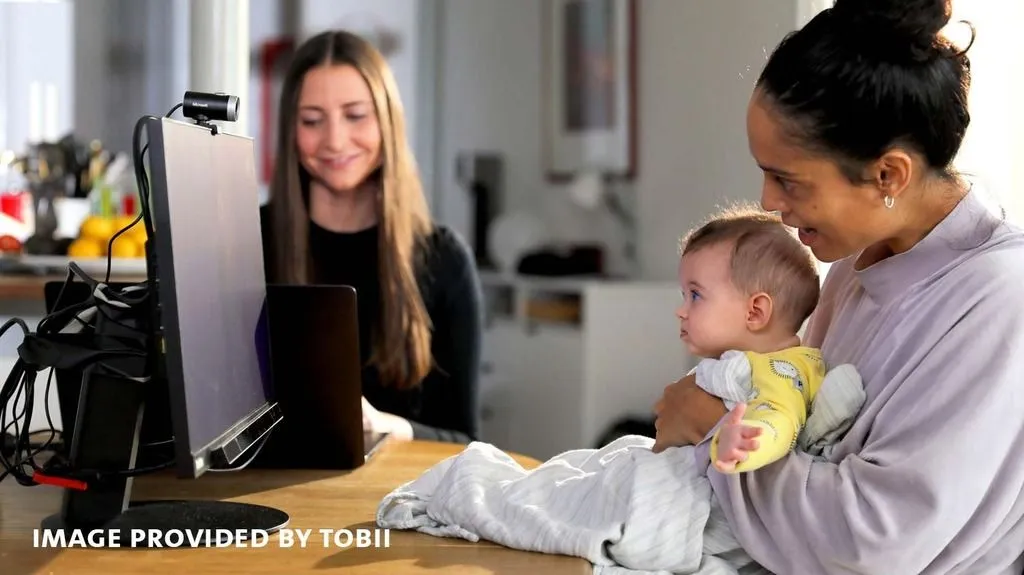
Wouldn't every researcher want to automate certain measurements and save valuable time? In the 19th century, the study of eye movements for instance was done by means of direct observations! Can you imagine the time investment?
Examples of eye tracking lab set-ups
Fortunately, the process of measuring the point of gaze or the motion of an eye relative to the head - shortly called eye tracking - can now easily be automated. Direct observations are nowadays used to observe the surroundings or specific behaviors of the test participant where necessary. These observations add extra information to the eye tracking data.
Automated measurements
Eye trackers, mobile or stationary, have proven to be effective and reliable tools to assist researchers in answering questions about for example attention processes. They enable you to see what exactly your test participant is looking at, and is not looking at, or missing during interactions.
Find out more: What can you use eye tracking for?
Eye tracking devices
Eye trackers are available in multiple formats: there are mobile unites like glasses, stationary eye trackers or VR units including eye tracking, each with unique benefits. Computer-monitor eye trackers are stationary and are also commonly used in an office setting.
Mobile eye trackers like glasses can provide insight in real-life settings into consumers' or users' attention and responses to product placement or other stimuli.
FREE WHITE PAPER
Webcam-based eye tracking
Download this white paper to learn about:
-
check_circle
The technology behind webcam-based eye tracking
-
check_circle
Validation of its accuracy
-
check_circle
Practical applications and usability
Read now
arrow_forward
Eye trackers integrated in a lab
Eye trackers are often integrated into lab set-ups, for example in a game lab or in a simulator. They add substantial power to a lab set-up, as they produce gaze path video and large quantities of rich data, all related to attention and emotion.
Eye tracking in developmental psychology research
Eye tracking is a valuable method in developmental psychology, providing insights into how infants and children perceive and interact with the world around them. Observational research often takes place in a specialized observation lab that mimics a home environment, allowing researchers to study natural behavior unobtrusively during parent–child interactions and developmental processes.
Because infants are unable to provide verbal feedback, researchers rely on nonverbal signals such as facial expressions and gaze patterns to understand their emotional and cognitive responses. These subtle cues reveal how infants explore their surroundings and react to social stimuli, offering a window into early emotional development.
Combining observation with technology
In a controlled lab environment, eye tracking can accurately measure where and how long infants look at certain stimuli, shedding light on exploratory and emotional behavior. When combined with synchronized video recordings, researchers gain a more complete picture of developmental changes and attention patterns.
Automated facial expression analysis
Complementary tools such as Baby FaceReader can automatically measure facial expressions in infants aged 6 to 24 months. Based on the Baby FACS1 system, it identifies specific facial movements to analyze expressive and cognitive behavior in both naturalistic and experimental settings, including parent–child interactions.
FREE WHITE PAPER
Facial Action Coding System
Download here the FREE white paper 'Facial Action Coding System (FACS)' and learn more about:
-
check_circle
Objective results with FACS
-
check_circle
Action Units
-
check_circle
Examples using FACS
Submit to download
arrow_forward
Differentiating between task experiences
Office software, games, or other applications can be evaluated by differentiating between participants with and without previous task experience. When a participant has previous experience with a website, game, or other application, the scan path of the eyes will most likely have fewer fixations than the scan path of a participant with no previous experience.
In all of these lab set-ups eye tracking can also be used to obtain data such as pupil height and width, ocular torsion, pupil position, velocity of eye movement/saccades, and location and duration of eye fixation.
Record all data in perfect sync
When working with multiple data sources such as eye tracking, physiological measures, and behavioral observations, managing and synchronizing all these streams can become complex. NoldusHub offers a smart and centralized solution to bring all your data together.
With NoldusHub, you can easily connect devices like eye trackers, and physiological sensors, and record their data in perfect sync. The platform enables you to visualize, monitor, and validate all incoming signals in real time, ensuring data quality and consistency across sessions.
Using eye tracking in combination with research software such as The Observer® XT allows researchers to specify subjects and behaviors which can be coded during a test and afterwards played back alongside the eye tracking data. Eye trackers usually produce multiple data modalities, such as a video image of the participant's field of view, hotspots, pupil width, fixations, and areas of interest (AOI). In The Observer XT video coding software you can synchronize all data and analyze it to see exactly what happened in an experiment.
Read more on eye tracking, data integration, and multi-modal data:
Reference
Oster, H. (2016). Baby FACS: Facial Action Coding System for infants and young children. Unpublished monograph and coding manual. New York University.