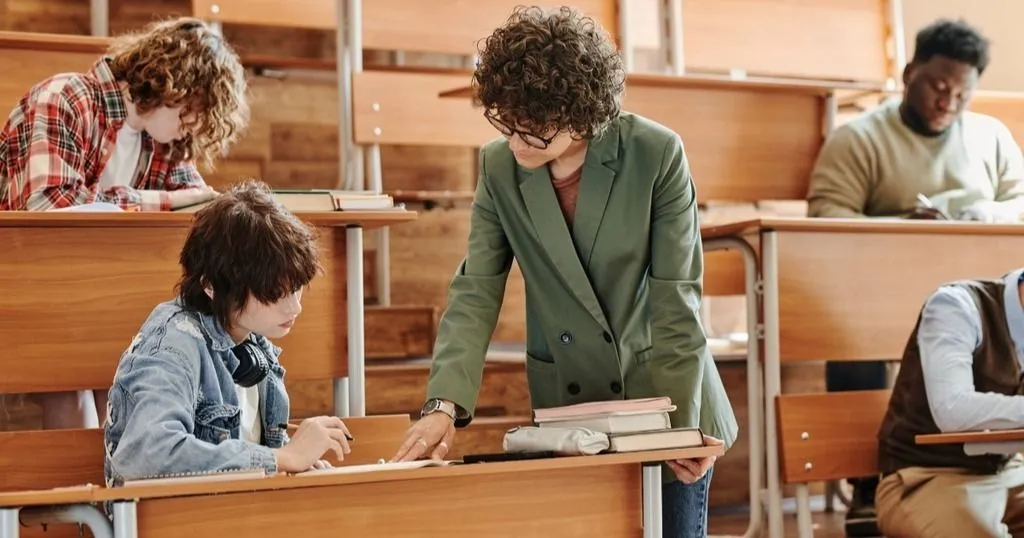
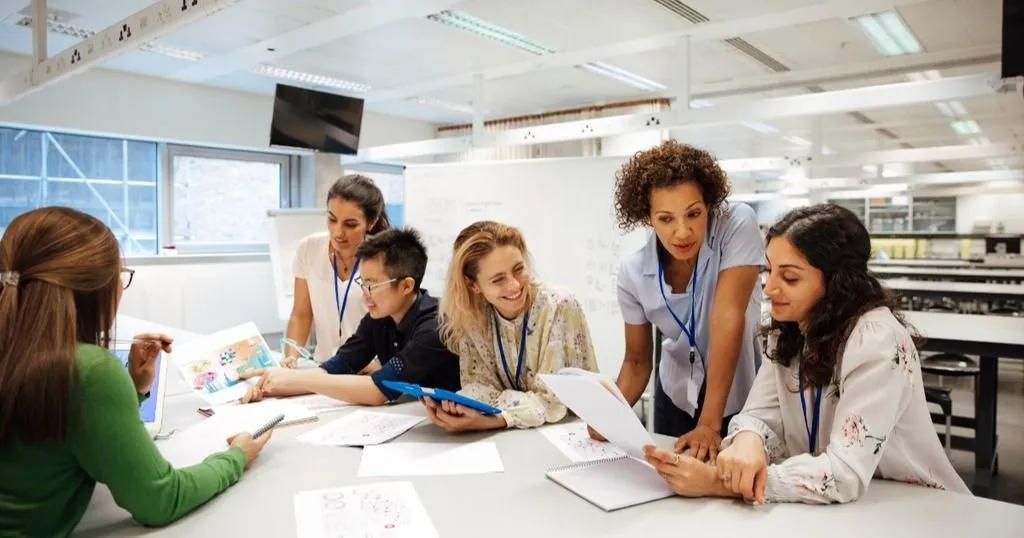
Many researchers focus on classroom interaction to learn more about group dynamics, teaching behavior, and student engagement. One of the research methods used is behavioral observation. By using video and audio recording equipment placed in a classroom, researchers collect the material they need to improve teacher-student interaction, evaluate interventions, and much more.
Here are three examples of how researchers observe adolescents and teachers in a classroom using the latest tools and techniques.
Example nr. 1: Teacher training
Marie Bocquillon of the University of Mons, Belgium explains how she uses technology like IP cameras, microphones, and software from Noldus in order to improve the training of teachers. "We are observing things like: what kind of questions are said, what kind of feedback do the future teachers use in front of their students? Do they check for understanding? Are they talking with each student, and not only with the two or three good students? Things like that we can see with an observation."
She explains in this video that it is challenging to find the right balance between seeing the bigger picture and coding behaviors in great detail.
Taking that into consideration, it is always advised to think about what questions you actually want to answer and what behavioral coding is necessary to answer these questions.
Example nr. 2: Evaluate an intervention program
Behavioral role play is often used to look into thought processes and behaviors. David Wolfe and colleagues from the University of Toronto, Canada made use of this method and evaluated a classroom-based healthy relationship program.
This study included classroom observations of in total 21 lessons. Older students were asked to participate as actors in the role playing exercise: bullying or pressuring the participants of the study for example.
To capture all responses, David Wolfe and colleagues recorded the interactions on video and coded relevant behaviors afterwards. The Observer XT included the behavioral coding scheme Wolfe and his team developed: delay, refusal, negotiation, yielding, and compliance.
FREE WHITE PAPER
How to set up a coding scheme
Download here the FREE white paper 'How to set up behavioral coding - 7 tips' and learn more about
-
check_circle
Defining your behavior group
-
check_circle
Point events
-
check_circle
Coding from a diversity of sources
Download
arrow_forward
These classroom observations provided the researchers with information about the strategies adolescents used when managing the interactions. One of the conclusions drawn was that adolescents who participated in the program showed more negotiation skills and delay tactics compared to adolescents who did not participate.
By combining this behavioral study with a post-intervention study, these researchers are able to determine the success of an intervention program.
Example nr. 3: Student-teacher interaction study
Researchers from the Netherlands (Cents-Boonstra et al. 2021) teamed up to explore patterns in teachers' use of specific motivating teaching behaviors in relation to students' positive engagement. Results from this particular study showed that specifically asking motivating questions and providing positive feedback and support during exercises were associated with subsequent positive student engagement.
FREE WHITE PAPER
Video feedback in skills education
10 Reasons why video feedback is essential in skills education.
-
check_circle
Benefits for students
-
check_circle
Advantages for teachers and trainers
-
check_circle
Practical examples
Download
arrow_forward
In the paper, published in the European Journal of Psychology of Education, you can find the complete coding scheme. It comprises of the actor (teacher), value (motivating), and the behavior (provides choice, provides (non) verbal positive feedback). Moreover, you can also find coded examples, like 'Super', 'Very good', and 'Thumbs up' to see exactly how the researchers quantified behavior.
It was mentioned that the student engagement was coded for all the students as one actor since the focus was on the teacher in this study. When coding individual student behavior in the future, the researchers could discover more about the interactions of students with different degrees of engagement, with the same teacher making the individual student's behavior part of the classroom dynamics.
Also read: 10 reasons why AV tool Viso is beneficial for video feedback [INFOGRAPHIC]
References
- Cents-Boonstra, M.; Lichtwarck-Aschoff, A.; Lara, Mascareno Lara, M.; Denessen, E. (2021). Patterns of motivating teaching behavior and student engagement: a microanalytic approach. European Journal of Psychology of Education, 37, 227-255. https://doi.org/10.1007/s10212-021-00543-3
- Cents-Boonstra, M.; Lichtwarck-Aschoff, A.; Denessen, E.; Aelterman, N.; Haerens, L. (2021). Fostering student engagement with motivating teaching: an observation study of teacher and student behaviours. Research papers in Education, 36 (6). https://doi.org/10.1080/02671522.2020.1767184
- Wolfe, D.A.; Crooks, C.V.; Chiodo, D.; Hughes, R.; Ellis, W. (2012). Observations of adolescent peer resistance skills following a classroom-based healthy relationship program: a post-intervention comparison. Prevention Science, 13, 196-205. https://doi.org/10.1007/s11121-011-0256-z