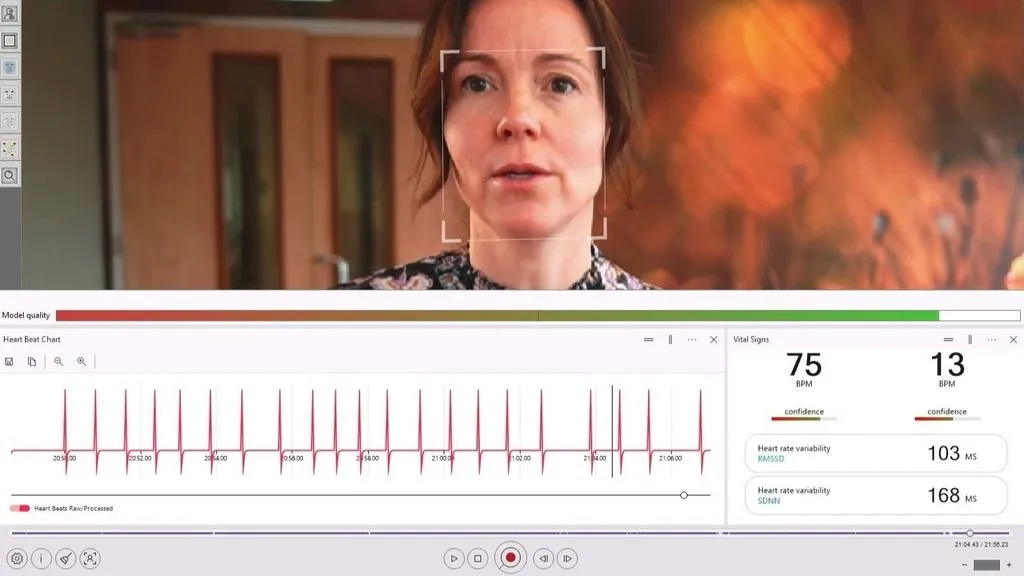
Are you involved in research with emotion recognition or facial expression analysis? These 5 tips will guarantee the best results!
How to optimize your facial expression analyses
Emotion data provides crucial insights that allow researchers to gain insight in complex human behaviors in greater depth. Facial expression analysis software like FaceReader™ is ideal for collecting this emotion data. Do you want to get the best results from your experiments? These 5 tips will help to optimize your facial expression analyses.
1. The whole face should be visible
You may normally offer your test participants something to eat or drink during the test to make them feel comfortable. However, when eating or drinking, the test participant blocks part of the face with his/her hand and the cup/glass/spoon. So, make sure the test participant finishes his/her cup of coffee before you start the test… unless, of course, the purpose of the test is to see a reaction to a new food or beverage!
There are still steps you can take to minimize interference: if testing a soda, for example, test participants could drink through a straw, which would ideally be transparent and colorless.
A tip to consider: Some people have a natural tendency to touch their face without realizing it. You may want to warn the test participants to keep their arms on the table throughout the test in order to get the best possible results.
2. Make sure the test participant looks into the camera
Rotation of the face is OK with automatic facial analysis, but it should be limited (<40°). That means that you should sit opposite of the test participant and not next to him/her if you want to ask questions during the test. In a social interaction setting (medical student – patient or consultant - client interaction) you would ideally position the camera on the conversation partner’s shoulder.
With this set-up, people almost look straight into the camera when they talk to their partner. In practice, this may not always be possible. But if you put the camera a short distance away, at the same height, with direct sight line to the participant’s face, you have a working solution.
A tip to consider: In a taste-test study, you can use a cup or bowl holder so the dish is closer to the face and the test participant does not need to tilt the head downward as much to taste the drink/food.
Another tip to consider: If you're asking clients to read instructions or answer a questionnaire, you can present this information on a screen with the relevant text and attach the camera to the screen, or use an on-board webcam.
FREE WHITE PAPER
FaceReader methodology
Download the free FaceReader methodology note to learn more about facial expression analysis theory.
-
check_circle
How FaceReader works
-
check_circle
More about the calibration
-
check_circle
Insight in quality of analysis & output
Submit to download
arrow_forward
3. Test people in their natural environment
When you include emotional expression analysis in your research, you hope to see some displayed emotions. “All my test participants looked neutral throughout the test” is an often-heard complaint. It may help to test people in their home or other familiar environment (like a restaurant, school, office, etc.).
Running your tests in the test facilities at your office has the obvious advantage that you can control the test conditions much better than out in the field. The downside, however, is that people may react differently to your stimuli. Particularly when you're interested in emotions, this is a major factor to take into account.
Noldus has created new software, FaceReader Online, to allow testing to occur at home. With FaceReader Online, participants can view an advertisement or series of images/ads at home, with all results sent directly to you upon completion. You can also import your FaceReader Online data into the FaceReader 9.1 software for additional analyses, helping you to gain even more insights in your data.
A tip to consider: Testing people via an online service also allows collection of data from people in remote locations, which can help to gather more diverse demographic data.
4. Real products are best
What approach is best to use when testing your product? You can show test participants pictures of your product, videos/commercials featuring your product, or you can give them the real product to view. What we have seen is that real products elicit greater responses. While having the real product at hand to view it is preferable to seeing a photo, real-life use is even more preferred.
So, if you wanted to know whether your test participants like your new healthy flour mix, for example, you can ask them to bake pancakes in a test kitchen, and observe the displayed reactions during the baking process and the consumption phase.
A tip to consider: Making the environment as natural as possible when doing this type of testing will elicit the most “real” emotional response!
Interesting read: Three ways to understand consumer emotions
5. Present more than one stimulus
If you want to test your new product (like a commercial, beverage, etc.), it is best to embed it in a series of other products. In this way the test participants do not concentrate fully on the focus product and will respond in a more natural way. This also allows the participant to evaluate your product compared to similar, and to allow the emotion response to be evaluated compared to other products.
A tip to consider: Be sure to randomize the order in which you present the products.
There you have it: five useful tips to help optimize your facial expression analysis. Want to learn more about facial expression analysis or how FaceReader works, and what's possible and impossible to do with FaceReader? Make sure to check these resources!
RESOURCES
Read more about FaceReader
Find out how FaceReader is used in a wide range of studies and how it can elevate your research!
-
check_circle
Free white papers
-
check_circle
Customer success stories
-
check_circle
Featured blog posts
Resources
arrow_forward